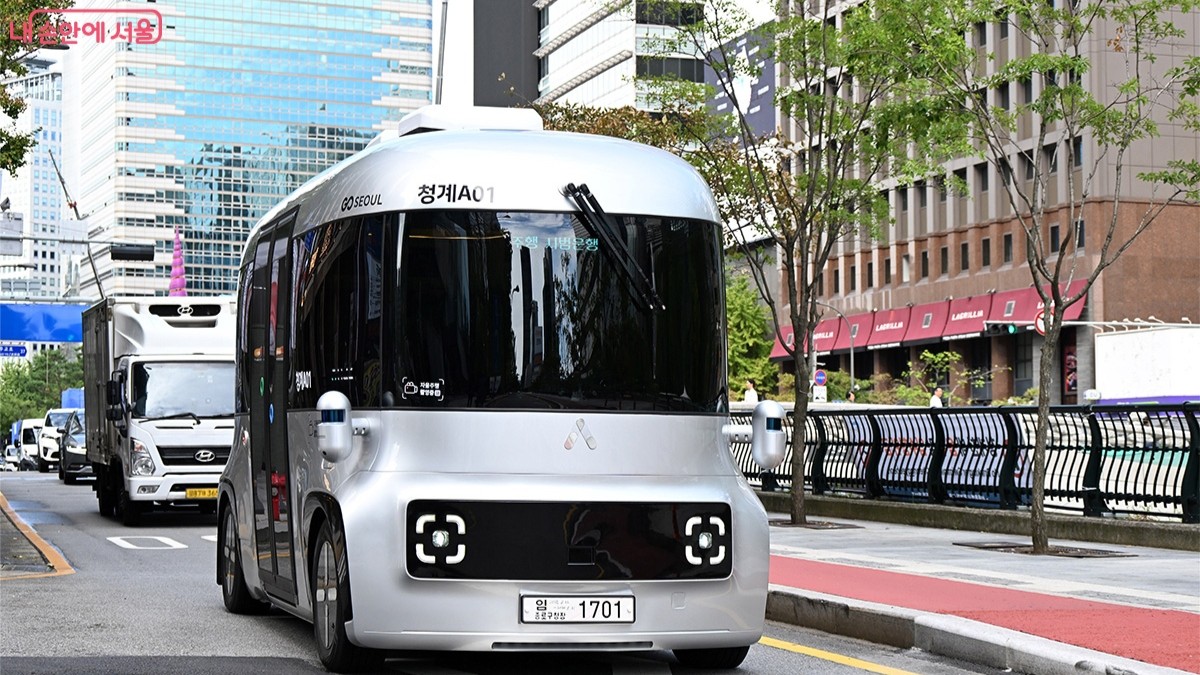
Seoul is transforming its famous streamside streets into a showcase for the future of urban travel. On 22 October 2026, South Korea‘s capital launched free evening operations of Cheonggye A01, an autonomous shuttle travelling alongside Cheonggyecheon Stream. The Seoul self-driving bus connects historic commercial streets with some of the city’s most popular visitor districts.
Beginning at 7 pm, the service brings futuristic transport into an area celebrated for traditional markets, illuminated walkways and lively restaurants. According to the Seoul Metropolitan Government’s official announcement, the initiative aims to make evening journeys more convenient while strengthening the city’s night-time tourism economy.
South Korea Achieves a Significant Milestone in Autonomous Night Transport
In a city already experimenting with automated public transport, this development marks a specific technological milestone. Seoul describes Cheonggye A01 as South Korea’s first regularly scheduled night-time autonomous bus without a conventional driver’s seat or steering wheel. This does not mean the country has never operated another automated shuttle or night-time autonomous service. The achievement lies in combining this distinctive vehicle design with regular evening operations.
The development shows how technology previously tested during daytime journeys can support transport after sunset. It also provides valuable experience in conditions where lighting, road activity and passenger requirements can differ considerably from daytime travel.
Cheonggyecheon Night Bus Connects Major Attractions Across Central Seoul
The Cheonggyecheon night bus operates along a 4.8-kilometre round-trip route between Cheonggye Plaza and Cheonggye 5-ga, close to Gwangjang Market. The journey passes Cheonggye 3-ga and the Sewoon Shopping Arcade district. Two vehicles circulate along the corridor, serving important commercial and cultural locations. The relatively short route places the shuttle near restaurants, shopping streets and recognised sightseeing destinations.
Visitors can use it to travel between attractions rather than covering the entire distance on foot. The vehicles operate on nearby roads, not within the pedestrian walkway beside the stream. This arrangement combines urban mobility with access to Seoul’s established tourism infrastructure.
Advertisement
Advertisement
Eleven Carefully Positioned Stops Open Up Seoul’s Historic Commercial Heart
The service covers eleven designated stops across both directions. Outbound passengers travel from Cheonggye Plaza through Gwanggyo, Samilgyo, Gwansugyo and Baeogae Bridge before reaching the Gwangjang Market turning point. The return route includes Sewoon Bridge, Gwansugyo, Supyogyo, Samilgyo and Jangtonggyo. These locations provide access to different sections of the Cheonggyecheon corridor.
The arrangement helps passengers combine sightseeing with shopping and dining in nearby neighbourhoods. However, outbound and return stops are not always identical. Visitors should check their intended direction before boarding. This simple precaution can prevent confusion when travelling through unfamiliar streets after dark.
Advertisement
Advertisement
Evening Timetable Brings Regular Departures Until Nearly Midnight
The new schedule focuses on weekday evenings, when people visit restaurants, markets and city-centre attractions after work. Services operate from 7 pm until 11.50 pm, with departures from Cheonggye Plaza every thirty minutes. The first vehicle leaves at 7 pm, followed by departures at 7.30 pm, 8 pm and subsequent half-hour intervals.
The final departure takes place at 11 pm, with the journey ending at 11.50 pm. Seoul schedules nine departures from Cheonggye Plaza each operating day. Two vehicles alternate to maintain the timetable. Importantly, the service does not operate on Saturdays, Sundays or public holidays.
Free Autonomous Bus in Seoul Makes Future Transport Accessible
Passengers can experience this innovative service without paying a fare during its introductory period. However, everyone must tap a compatible public transport card when boarding, even though no money is deducted. Seoul plans to introduce paid operations later, with a proposed adult fare of 1,400 South Korean won. The authorities have not announced a definite date for this change. For now, the free autonomous bus in Seoul gives travellers an affordable addition to their evening itinerary.
It also allows residents to experience new technology firsthand. Nevertheless, free travel does not guarantee a seat, especially when passenger demand exceeds the shuttle’s limited capacity.
Advertisement
Advertisement
Futuristic ROii Vehicles Bring Advanced Korean Technology Onto City Streets
Cheonggye A01 uses ROii vehicles developed by the South Korean autonomous mobility company Autonomous A2Z. These compact shuttles eliminate the conventional driving position, creating a distinctive interior that immediately separates them from ordinary buses. A large onboard display provides information about the journey and autonomous driving system. Seoul’s August 2026 passenger guide also describes a wheelchair boarding lift, supporting more inclusive transport.
The vehicle represents a practical demonstration of Korean mobility technology in everyday surroundings. However, its significance goes beyond appearance. It allows the city to examine how automated vehicles perform while carrying passengers through established commercial districts.
Human Safety Supervision Remains Central to Every Autonomous Journey
Despite its unusual design, the shuttle does not operate without human supervision. Seoul places one safety operator aboard each vehicle to respond to emergencies and other situations requiring intervention. Each shuttle accommodates up to eight passengers, considerably fewer than a conventional city bus. These arrangements are important for understanding the present technology. The system performs automated driving functions, but human oversight remains part of its operation.
Small passenger capacity may also create queues during busy periods, especially when visitors are eager to try the service. The arrangement therefore combines technological experimentation with operational safeguards as Seoul develops its autonomous transport capabilities.
Extensive August Testing Prepared Seoul for Night-Time Operations
Before introducing its evening timetable, Seoul conducted night-time trial journeys in August 2026. External specialists participated in safety assessments to evaluate the system before regular public operations began. Such preparation is essential because darkness can change visibility, road conditions and the behaviour of surrounding traffic. Night-time testing also gives operators an opportunity to assess performance under different urban conditions.
The city used this process to support the transition from daytime journeys to evening services. Nevertheless, successful preparation does not eliminate every possible operational risk. Continued monitoring, careful supervision and responses to changing road conditions remain important as passenger services develop further.
Advertisement
Advertisement
Seoul Ends Daytime Operations to Establish a Stronger Evening Identity
The introduction of the night service also changes how passengers use Cheonggye A01. Seoul had already operated the route during daytime hours, providing free journeys and gaining practical experience over approximately one year. With the October 2026 timetable change, those daytime operations ended. The vehicles now concentrate on evening journeys rather than running an additional daytime schedule. This distinction matters for tourists relying on older travel information.
Previous morning and afternoon departure times no longer apply. By focusing on the hours after sunset, Seoul is connecting its autonomous transport experiment more directly with evening sightseeing, dining, shopping and leisure activities.
Cheonggyecheon’s Illuminated Waterfront Creates an Unforgettable Night Attraction
Cheonggyecheon offers a striking contrast to Seoul’s busy commercial roads. The stream flows below street level, giving pedestrians a quieter place to explore the city. After sunset, lighting adds another dimension to the waterside landscape. Seoul’s official tourism guidance recommends the corridor for evening walks and highlights Cheonggye Soul Ocean, a media-art attraction near Gwanggyo Bridge.
Its published 2026 programme features projections between 6 pm and 10 pm, with seasonal adjustments. The new shuttle complements these experiences by connecting nearby attractions. Visitors can combine walking beside the water with a distinctive Seoul night travel experience aboard an autonomous vehicle.
Cheonggye Plaza Opens a New Gateway to Gwanghwamun’s Cultural Attractions
At the western end of the route, Cheonggye Plaza offers access to some of Seoul’s best-known civic and cultural spaces. Gwanghwamun Square lies within the surrounding central district, where public spaces, offices, restaurants and visitor attractions shape the city’s character. An evening outing can begin with a walk around these landmarks before moving towards Cheonggyecheon. The shuttle then provides a connection to commercial neighbourhoods further east.
This arrangement encourages travellers to discover several parts of central Seoul during one evening. However, passengers should remember that the vehicle is not a guided sightseeing tour. Some attractions require walking from the nearest designated stop.
Advertisement
Advertisement
Jongno and Bosingak Gain Another Connection to Evening Visitors
Jongno and Gwancheol-dong are among the commercial areas Seoul expects to benefit from the service. Around Jonggak, visitors can discover busy restaurant streets, shopping areas and the historic Bosingak Belfry. These destinations already attract evening activity, but moving between nearby districts can still interrupt a sightseeing itinerary.
Another transport option could make it easier to combine dinner with a streamside walk or a visit to a different neighbourhood. The wider economic opportunity involves encouraging visitors to explore rather than remain in one location. However, any increase in customer numbers or local spending must be measured before it can be attributed to the shuttle.
Euljiro and Sewoon Shopping Arcade Enter Seoul’s Future Mobility Network
Euljiro brings together established commercial streets, specialist shops, restaurants and changing cultural spaces. Near Cheonggye 3-ga, Sewoon Shopping Arcade serves as an important landmark along the autonomous shuttle route. This location places the service close to businesses that visitors might otherwise overlook during a short stay.
Convenient transport could encourage tourists to explore more streets and discover different aspects of Seoul’s urban culture. For independent traders, additional movement through the district represents a potential commercial opportunity. Nevertheless, transport improvements alone cannot guarantee higher sales. The lasting benefits will depend on whether passengers stop, explore and spend time within these neighbourhoods.
Gwangjang Market Emerges as a Major Beneficiary of the New Route
At the eastern end of the route, Gwangjang Market provides one of the most recognisable destinations connected by the service. The traditional market attracts visitors interested in Korean culture, shopping and local dining experiences. Cheonggye A01 approaches the market district at Cheonggye 5-ga before returning towards Cheonggye Plaza.
This connection allows travellers to combine market exploration with visits to attractions further west. It could also encourage more movement between established tourism areas during evening hours. The important advantage is convenience rather than distance alone. Successful city tourism often depends on how easily visitors can connect several memorable experiences within a limited period.
Advertisement
Advertisement
South Korea Night Tourism Receives a Powerful Boost From Seoul’s Wider Strategy
The launch forms part of a broader plan to strengthen Seoul’s night-time economy. In August 2026, the government introduced its 24-Hour Vibrant Economic City initiative, covering activities between 6 pm and 6 am. The strategy connects tourism, culture, transport, public safety and neighbourhood businesses.
Officials want visitors to stay longer while giving residents more opportunities to enjoy the city after work. Major night-time landmark areas include Dongdaemun Design Plaza, Namsan, Gwanghwamun and the Han River. Cheonggye A01 provides a smaller, practical example of how South Korea night tourism can develop through better connections between attractions and transport.
Seoul’s Surging International Tourism Numbers Reveal Enormous Growth Potential
Seoul’s official tourism figures show why the government is investing in new visitor experiences. Between January and August 2026, the capital welcomed approximately 11.56 million foreign tourists, an increase of 21.6 per cent from the previous year. Foreign visitor card spending climbed 59.9 per cent to around 7.78 trillion won.
August alone attracted approximately 1.72 million international visitors, representing annual growth of 23.3 per cent. These results demonstrate strong tourism demand before the shuttle’s evening launch. They also explain the city’s interest in improving connections between attractions. However, the figures cannot establish that autonomous transport has already increased tourism arrivals.
Traditional Markets Could Gain Fresh Opportunities From Longer Visitor Stays
The commercial opportunity becomes clearer when examining spending around traditional markets. Seoul’s October 2026 tourism report recorded a 127.4 per cent year-on-year increase in foreign card expenditure at Gwangjang Market. Across the city, smaller commercial streets recorded growth of 80.9 per cent, while traditional markets collectively experienced a 50.1 per cent increase.
These figures highlight rising interest in local shopping districts. However, the spending growth happened before the night shuttle began operating. It cannot be attributed to the new service. The real test will be whether improved evening access encourages longer visits, wider exploration and measurable economic benefits for neighbourhood businesses.
Advertisement
Advertisement
Essential Travel Advice Helps Visitors Enjoy the New Service Safely
Visitors planning a journey should search for Cheonggye A01 or 청계 A01 in Naver Map or KakaoMap. Seoul recommends these applications for stop locations and real-time service information. Passengers need a compatible transport card and should allow time for possible queues. Earlier municipal guidance described boarding as first-come, first-served without advance reservations.
It also identified wheelchair boarding facilities, although passengers requiring assistance should confirm current arrangements. Heavy rain, snow and road restrictions can affect operations. Travellers must wear seatbelts while aboard. Checking the schedule before departure will help visitors incorporate the shuttle into their evening plans without unnecessary disruption.
Seoul’s Ambitious Autonomous Bus Expansion Signals a Bigger Transport Revolution
The Cheonggye A01 launch also points towards Seoul’s wider transport ambitions. On 1 October 2026, the city announced an agreement with Hyundai Motor Company and the local bus operators’ association to advance Level 4 autonomous city buses. Development and trials are planned for 2027 and 2028, followed by deployment from 2029.
Seoul aims to introduce 500 autonomous city buses by 2030. That programme is separate from the small Cheonggyecheon shuttle. Nevertheless, the Seoul self-driving bus offers an early example of technology entering everyday public transport. For travellers, its immediate achievement is simpler: making Seoul’s extraordinary evenings accessible through an innovative new journey.