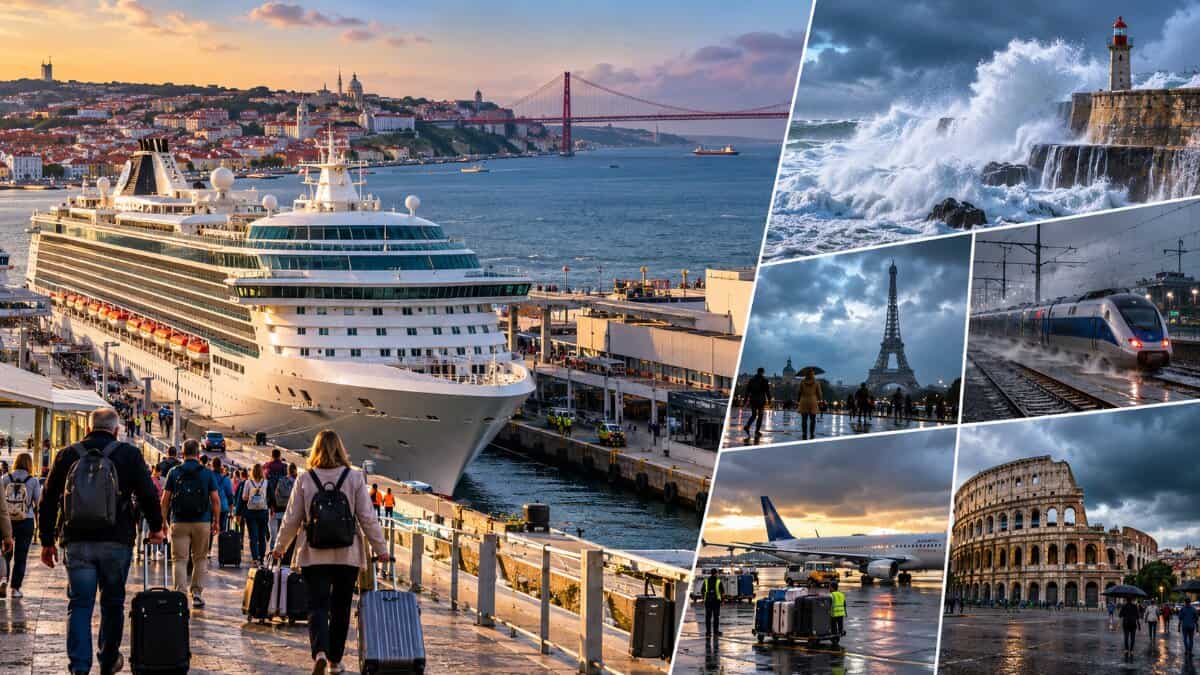
Portugal faces a significant cruise travel planning challenge on 28 October 2026. P&O Cruises’ Ventura is scheduled to visit Lisbon between 07:00 and 18:00, while the city’s metro workers have announced a partial strike from 05:00 to 10:00. The overlap creates three hours of potential transport disruption for passengers arranging independent shore excursions. Meanwhile, storm-related transport restrictions in the United Kingdom, France and Germany, alongside forthcoming Italian industrial action, are creating separate travel risks across Europe. The five developments are concurrent, not evidence of a single Europe-wide transport shutdown.
Portugal’s Lisbon Cruise Schedule Reveals an Overlooked Three-Hour Transport Risk
An examination of two independent institutional schedules reveals the central concern for cruise passengers arriving in Lisbon on Wednesday, 28 October.
Advertisement
Advertisement
According to Lisbon Cruise Port, P&O Cruises’ Ventura is expected to arrive at 07:00 and depart at 18:00. The ship therefore has an 11-hour scheduled port call.
However, Metropolitano de Lisboa confirmed on 16 October that workers had submitted notices for partial strikes on both 28 and 30 October, between 05:00 and 10:00.
Advertisement
Advertisement
Consequently, the first three hours of Ventura’s scheduled Lisbon visit fall inside the announced industrial-action window.
The timing is especially important for independent travellers planning to explore Lisbon without a cruise-organised excursion. Some may intend to use public transport to reach the historic centre, visit attractions or begin longer day trips.
Advertisement
Advertisement
Nevertheless, a strike notice does not automatically mean the entire metro network will close. The operator has sought minimum-service arrangements, and their effect on individual journeys must be verified through subsequent operational announcements.
The immediate travel alert therefore concerns a confirmed scheduling overlap and the risk of reduced transport availability, not a confirmed cancellation of Ventura’s Lisbon visit.
The Lisbon Port Call and Strike Timetable
| Operational detail | Official information | Implication for travellers |
|---|---|---|
| Cruise ship | P&O Cruises Ventura, voyage N628 | Relevant to passengers on this specific sailing |
| Scheduled arrival | 28 October, 07:00 | Arrival falls within the strike period |
| Lisbon Metro strike notice | 28 October, 05:00–10:00 | Morning journeys may face disruption |
| Direct overlap | 07:00–10:00, three hours | Alternative transport may be needed |
| Scheduled departure | 28 October, 18:00 | Shore activities must fit the confirmed return-to-ship deadline |
| Second metro strike notice | 30 October, 05:00–10:00 | Separate risk for later Lisbon visitors |
Timings are local to Lisbon. Sources: Lisbon Cruise Port and Metropolitano de Lisboa, checked against notices available on 26 October 2026.
P&O Ventura’s Seven-Night Itinerary Links Britain, France and Portugal
According to P&O Cruises, voyage N628 is a seven-night sailing scheduled between 24 and 31 October, departing from and returning to Southampton.
The published itinerary includes Cherbourg in France, Leixões for Porto, Lisbon and Vigo in Spain. Lisbon is the fifth day of the voyage.
P&O lists Ventura’s guest capacity at 3,086, although that figure must not be confused with the number of passengers actually travelling on N628.
Advertisement
Advertisement
The operator’s published itinerary establishes the planned route, not a verified record of every completed port call. Claims concerning a delayed Southampton departure or an omitted Cherbourg visit have not been independently established through the operator’s public operational notices reviewed for this report.
For passengers, the immediate priority is confirming the actual Lisbon arrival, berthing arrangements and shore-excursion programme.
Lisbon’s Cruise Terminal Offers Alternatives, but Capacity Remains Uncertain
The Lisbon Cruise Terminal is situated at Doca Jardim do Tabaco, close to the waterfront and historic city neighbourhoods.
The Lisbon Metro identifies Santa Apolónia station as serving the cruise terminal. The station operates on the Blue Line and normally opens at 06:30, with services scheduled until 01:00.
The station also provides connections with the national railway network and several bus routes. However, those connections should not be treated as guaranteed replacements during industrial action.
Walking may remain practical for some nearby activities, subject to personal mobility and weather conditions. Longer sightseeing trips, active excursions and independently organised tours require more detailed transport arrangements.
Advertisement
Advertisement
Private transfers, authorised taxis and pre-arranged excursion coaches offer possible alternatives. Availability, prices and pick-up locations should be reconfirmed before passengers disembark.
UK Storms Create the First Layer of European Travel Uncertainty
The United Kingdom entered the final week of October following successive severe weather systems.
According to the UK Met Office, Storm Austen affected the country on 23 October, followed by Storm Boelo over the weekend.
Storm Austen produced recorded gusts of 76 mph in the Isles of Scilly, while forecasts for Storm Boelo warned of gusts reaching 80 mph in exposed coastal locations.
Such conditions can restrict coastal operations, delay transport and complicate cruise embarkation planning.
However, the weather warnings alone do not prove that Ventura’s departure was delayed.
Advertisement
Advertisement
For agents managing Southampton cruise departures, the lesson extends beyond one vessel. Railway access, road journeys, hotel transfers and ship movements require separate checks whenever severe weather affects the embarkation region.
France’s Normandy Railway Disruption Adds a Verified Cross-Border Connection
France experienced confirmed transport disruption from Storm Austen during the same period.
According to SNCF Nomad Train, railway services across Normandy were suspended between 23 and 24 October as a precaution against dangerous conditions.
Damage to electrical infrastructure between Caen and Cherbourg subsequently created additional restrictions. The operator identified possible cancellations and delays on Caen–Cherbourg and Caen–Granville–Rennes services.
Further disruption remained possible on 25 October because of Storm Boelo.
This provides a genuine connection between British and French travel disruption.
Advertisement
Advertisement
It does not establish that SNCF’s railway restrictions caused changes to Ventura’s cruise itinerary.
The practical concern is broader: travellers combining a cruise with independent French railway journeys could experience problems even when their ship or accommodation booking remained valid.
Germany’s North Sea Ferry Cancellations Expose Another Coastal Tourism Risk
Germany provides another example of severe weather affecting transport-dependent tourism.
On 26 October, ferry operator Wyker Dampfschiffs-Rederei published timetable restrictions for services involving Föhr and Amrum.
The operator also announced that services to and from the Halligen islands would not operate that day because of predicted high water levels and associated flooding.
These restrictions matter particularly to independent island visitors, walking holidaymakers and travellers relying on ferry connections.
Advertisement
Advertisement
Germany is not part of Ventura’s published voyage. Its relevance is the shared exposure of coastal tourism infrastructure to disruptive autumn weather, rather than a direct operational connection with the Lisbon cruise call.
Portugal’s Azores Strike Is Separate From Lisbon’s Metro Dispute
Portugal faces two distinct industrial-action risks, and accurate reporting must distinguish them.
According to SATA Group, ground-handling staff in the Azores are covered by strike notices running from 21 October to 3 November.
The announced periods are 07:30–10:30 from 21 to 27 October and 16:00–19:00 from 28 October to 3 November.
SATA Air Açores and Azores Airlines warn that affected flights may experience delays or operational adjustments. The group has introduced flexible rebooking conditions for eligible passengers.
This action does not establish a ground-handling strike at Lisbon Airport.
Advertisement
Advertisement
The mainland metro dispute creates the direct risk for Ventura’s Lisbon shore visit. The Azores dispute affects a separate island aviation network.
For travel businesses selling combined mainland and island itineraries, both notices deserve attention, but they require different contingency plans.
Italy’s Late-October Industrial Action Adds Pressure to European Travel Planning
Italy’s transport strike calendar introduces further uncertainty during the same travel week.
According to the Italian Ministry of Infrastructure and Transport, Trenitalia customer operations personnel at Bologna, Reggio Emilia and Rimini are covered by a regional strike notice from 21:00 on 28 October to 21:00 on 29 October.
An eight-hour local public transport stoppage involving AIR Campania personnel in Naples is also listed for 28 October.
The ministry additionally records a nationwide general strike notice for 30 October, including specified railway and port-sector actions.
Advertisement
Advertisement
However, the Italian aviation regulator, ENAC, identifies 30 October–5 November as a protected period during which aviation strikes are prohibited. Consequently, the ministry’s aviation strike listings require regulatory clarification before any airport-wide stoppage can be presented as confirmed.
Italy’s actions are not linked operationally to Ventura’s western European voyage. They matter to international agents managing separate Italian departures and connecting itineraries during the same week.
Five-Country European Travel Disruption Assessment
| Country | Verified development or official notice | Main traveller exposure |
|---|---|---|
| United Kingdom | Storms Austen and Boelo, 23–25 October | Coastal travel, rail access and journey planning |
| France | Normandy railway suspensions and residual restrictions | Railway connections and regional transfers |
| Germany | North Sea island ferry cancellations, 26 October | Island access and coastal tourism |
| Portugal | Lisbon Metro strikes announced for 28 and 30 October; separate Azores handling dispute | Cruise excursions, urban mobility and island aviation |
| Italy | Regional railway action, 28–29 October; general strike notice, 30 October | Rail journeys, local transport and potentially port operations |
All developments originate from transport operators, regulators or official weather and government notices. The table does not imply identical disruption levels or a shared cause across the five countries.
Lisbon’s Cruise Economy Shows Why a Short Transport Interruption Matters
Lisbon’s cruise industry represents a substantial visitor market.
According to Lisbon Cruise Port statistics, the port recorded 335 cruise calls and 705,437 passenger movements in 2025.
Of those movements, 499,211 were transit passengers and 206,226 were turnaround passengers. The latter category reflects embarkation and disembarkation activity.
Advertisement
Advertisement
| Lisbon cruise indicator | 2024 | 2025 |
|---|---|---|
| Cruise calls | 369 | 335 |
| Total passenger movements | 763,752 | 705,437 |
| Transit passenger movements | 591,797 | 499,211 |
| Turnaround passenger movements | 171,955 | 206,226 |
A city receiving hundreds of thousands of cruise passenger movements must coordinate ships, terminals, coaches, attractions and public transport.
A morning metro restriction can affect that coordination without preventing a vessel from docking.
No official estimate has established the financial impact of the 28 October action on Ventura passengers or Lisbon businesses.
The Overlooked Risk Is Lost Excursion Time Rather Than a Cancelled Cruise
The most important analytical finding concerns how a short urban transport interruption can reduce the useful duration of a cruise visit.
Ventura’s scheduled Lisbon stay lasts 11 hours. The metro strike overlaps three of those hours, equivalent to approximately 27 per cent of the published berthing window.
That percentage does not mean passengers will lose 27 per cent of their sightseeing time. Actual losses depend on disembarkation arrangements, available minimum services, alternative transport and the time required to return aboard.
Advertisement
Advertisement
Nevertheless, the overlap creates an identifiable operational vulnerability.
A passenger whose excursion depends on reaching a distant departure point early in the morning may have fewer alternatives than someone planning a flexible waterfront walk.
Similarly, an excursion operator could face challenges if vehicles arrive late, pre-booked attraction slots cannot be changed or return journeys take longer than expected.
The exposure therefore differs across passenger groups.
Independent visitors may carry more responsibility for checking transport and reaching the ship before the required boarding deadline. Organised excursions may have dedicated vehicles, although their operations still depend on local road and service conditions.
For cruise businesses, this suggests that shore-side transport resilience should be assessed separately from the ability of a port to accommodate a vessel.
Advertisement
Advertisement
A cruise can operate according to its published schedule while the practical visitor experience becomes less predictable.
Cruise Booking Conditions Make Early Communication Essential
According to P&O Cruises’ booking conditions, advertised itineraries can be altered after departure, and individual port calls are not guaranteed.
The operator also distinguishes separately purchased shore experiences from the principal cruise package. Specific booking arrangements therefore determine the options available when an excursion changes or cannot proceed.
A local metro strike does not automatically establish entitlement to a full cruise refund or compensation.
Passengers should retain their excursion confirmations, receipts and transport notifications. Anyone facing a material change should seek guidance from the relevant operator and examine applicable travel insurance conditions.
Agents should avoid making compensation promises before the contractual position and actual service impact are known.
Advertisement
Advertisement
Critical Risk-Management Priorities for Travel Agents and Tour Operators
- Verify Ventura’s final arrival and departure timings directly with P&O Cruises and Lisbon Cruise Port before issuing updated excursion instructions.
- Monitor Lisbon Metro’s 28 October operating announcement, including any minimum-service decision or revised reopening arrangements.
- Arrange suitable transport alternatives for passengers with fixed excursion appointments, reduced mobility or longer journeys.
- Protect the return-to-ship deadline by allowing additional time and communicating the boarding cut-off specified by the cruise operator.
- Separate national disruption notices so clients do not confuse Azores aviation strikes, Italian rail action and German ferry cancellations with Lisbon’s local metro dispute.
- Document changes and costs to support customer assistance, supplier discussions and eligible insurance claims.
Europe’s Late-October Disruption Highlights a Wider Shift in Travel Risk Management
The developments of 23–30 October demonstrate how different transport vulnerabilities can emerge simultaneously across Europe.
Severe weather has affected British and French travel networks and German island transport. Labour disputes have created separate risks in Portugal and Italy.
Lisbon’s 28 October cruise call reveals a particularly important issue: international tourism depends not only on the availability of flights, ships and accommodation, but also on reliable connections between arrival points and visitor activities.
For the cruise industry, better coordination between port authorities, urban transport providers and excursion suppliers could reduce preventable disruption.
For travel agents, the strategic priority is increasingly clear. Itinerary management must extend beyond confirmed reservations to include local operational intelligence, contingency transport and realistic connection times.
That approach will become more valuable as destinations manage high visitor volumes alongside weather disruption, infrastructure constraints and industrial disputes.
Advertisement
Advertisement
FAQs
1. Is P&O Ventura’s Lisbon visit on 28 October 2026 cancelled?
No cancellation has been established from the official cruise and port schedules reviewed. Lisbon Cruise Port continues to list Ventura for arrival at 07:00 and departure at 18:00. Passengers should confirm subsequent operational changes with P&O Cruises.
2. Will Lisbon Metro close completely on 28 October?
A partial strike has been announced between 05:00 and 10:00. The precise effect on services depends on subsequent operating arrangements, including any minimum-service decision. A complete network closure should not be assumed.
3. What should independent cruise passengers do in Lisbon?
Check metro availability before disembarking, consider pre-arranged transport, keep sightseeing plans flexible and allow sufficient time to return to the terminal before the ship’s official boarding deadline.
4. Are Portugal’s Azores airport strikes connected to the Lisbon Metro strike?
No. The Azores handling dispute involves aviation ground services, while the Lisbon Metro action concerns urban railway workers. They are separate labour disputes affecting different transport networks.
5. Are the United Kingdom, France, Germany, Portugal and Italy experiencing one connected travel crisis?
No. They face contemporaneous transport risks involving storms, ferry restrictions and industrial action. Some weather disruption is geographically related, but the available official evidence does not establish one continuous chain of cancellations or a uniform Europe-wide transport shutdown.