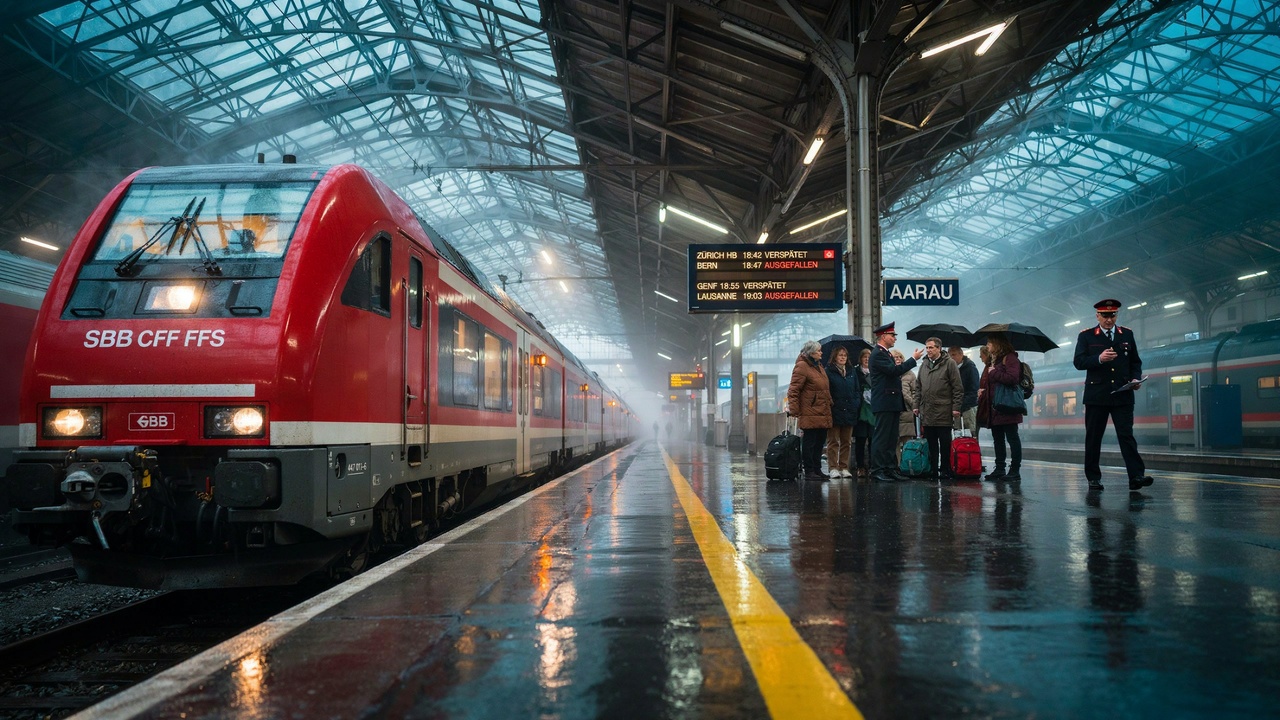
Switzerland’s railway network experienced widespread disruption on Friday, 23 October 2026, after an incident involving a person forced the suspension of train services around Aarau, interrupting an important corridor between Zurich, Bern and western Switzerland. The emergency coincided with severe weather damage around Lausanne and Renens, where power supply problems caused additional cancellations and delays. Swiss Federal Railways (SBB) introduced diversions through Basel and Lucerne, while replacement buses were arranged between Aarau and Rupperswil. The simultaneous incidents complicated evening journeys for commuters, domestic passengers and international travellers navigating several interconnected railway corridors.
The disruption came at a particularly difficult time for passengers travelling on Friday evening, when services across Switzerland connect major cities with regional destinations and neighbouring European countries. By the time railway authorities were responding to the incident at Aarau, storm-related problems had already restricted services around Lake Geneva.
Advertisement
Advertisement
The severity of the situation was compounded by reports of inconsistent passenger information. Some travellers at Zurich Hauptbahnhof were reportedly directed towards trains using the disrupted corridor, while other railway personnel recommended alternative routes through Basel or Lucerne.
Local news outlet Aarau24 confirmed that police and emergency services were present at Aarau by 8.18pm, with the railway incident manager arriving at 8.29pm. Railway restrictions were initially expected to continue until approximately 11pm, although that estimate did not constitute confirmation that all services would resume normally at that time.
The simultaneous incidents raise important questions about rail network resilience, the coordination of disruption information and the practical protections available to passengers stranded by unexpected interruptions.
What Happened Near Aarau on 23 October 2026?
Rail traffic between Aarau and Rupperswil was completely suspended on Friday evening following an incident involving a person, according to Aarau24 and reporting by the Swiss national news agency Keystone-SDA.
Advertisement
Advertisement
The affected section lies in the canton of Aargau, on a strategically important railway corridor used by long-distance and regional services.
Aarau is a major interchange within the Swiss rail system. Its location between Zurich and Olten makes it particularly important for journeys continuing towards Bern, Basel and western Switzerland.
Advertisement
Advertisement
When railway movements are halted along this section, the impact can extend considerably beyond the two neighbouring stations.
Trains may need to be held at intermediate stations, cancelled before departure or redirected along alternative routes. Passengers travelling on connecting services can also experience substantial disruption even when their original departure station is some distance from Aarau.
The exact personal circumstances surrounding the incident were not disclosed in the verified reporting reviewed. Aarau24 stated that further details about those involved were unavailable.
This distinction is important. The interruption itself was confirmed, but no responsible conclusion can be drawn about the cause, outcome or circumstances affecting the individual.
Advertisement
Advertisement
Emergency Response Timeline at Aarau
The local report provides several specific details about the operational response.
| Date and time | Reported development | Source |
|---|---|---|
| 23 October, Friday evening | Rail traffic interrupted between Aarau and Rupperswil | Aarau24 |
| By 8.18pm | Police and emergency services present at Aarau | Aarau24 |
| 8.29pm | SBB railway incident manager arrived | Aarau24 |
| 8.45pm | Further information about the potential reopening of individual tracks was expected | Aarau24 |
| Around 11pm | Initial estimated end of the restriction | SBB disruption information reported by local media |
| Exact reopening time | Not established by the initial reports | Unconfirmed |
All times refer to Switzerland’s local time on 23 October 2026.
The arrival of emergency responders and railway management personnel indicates that the incident required coordination between railway operations and public emergency services.
A railway incident manager typically works with the relevant operational teams to assess when train movements can safely resume. The presence of emergency responders does not, by itself, establish the severity of injuries or the circumstances of an incident.
Railway traffic can only be restored once the affected infrastructure has been cleared and the necessary operational permissions are in place.
Which Swiss Train Services Were Cancelled or Diverted?
The interruption affected numerous long-distance, interregional and S-Bahn services operating through the Aarau area.
Advertisement
Advertisement
Keystone-SDA reported that SBB disruption information identified the following service categories as affected:
| Train service | Network category | Reported impact |
|---|---|---|
| EC | EuroCity | Delays, cancellations or diversions |
| NJ | Nightjet | Disruption to affected services |
| IC1 | InterCity | Delays, cancellations or rerouting |
| IC3 | InterCity | Disruption |
| IC8 | InterCity | Disruption |
| IR16 | InterRegio | Disruption |
| IR35 | InterRegio | Disruption |
| IR37 | InterRegio | Disruption |
| IR55 | InterRegio | Disruption |
| RE12 | RegioExpress | Disruption |
| RE37 | RegioExpress | Disruption |
| S11 | S-Bahn | Disruption |
| S23 | S-Bahn | Disruption |
| S26 | S-Bahn | Disruption |
| S29 | S-Bahn | Disruption |
The original railway notifications also referred to additional InterRegio services without every affected journey being individually specified.
This table identifies the service lines listed in the disruption reporting. It does not mean that every train on each line was cancelled or that every section of each route became unusable.
The operational consequences varied according to individual services, departure times and the availability of alternative routes.
Why the Aarau–Rupperswil Section Matters
The Swiss railway system is highly interconnected. Major intercity services operate through central interchange points that allow passengers to travel between distant destinations with relatively few changes.
Aarau and Rupperswil form part of a network serving travel between eastern, central and western Switzerland.
Advertisement
Advertisement
For travellers heading from Zurich towards Bern, disruptions in this area can affect journeys continuing towards Fribourg, Lausanne and Geneva.
Passengers travelling between Biel, Grenchen, Olten and Zurich may also encounter revised connections.
The effects therefore spread beyond the immediate location of the emergency.
An interruption on a busy railway section can reduce the number of available paths for trains, creating congestion elsewhere as dispatchers attempt to accommodate services that would normally use the affected tracks.
Even after a line reopens, trains and crews may no longer be in the locations required by the original timetable. This can contribute to residual delays and service changes after the initial incident has ended.
Why Were Passengers Advised to Travel Through Basel or Lucerne?
SBB advised affected travellers to consider alternative routes through Basel SBB or Lucerne, depending on their intended destination.
Advertisement
Advertisement
These alternatives allow some journeys to avoid the closed railway section near Aarau.
The routing options were particularly relevant to passengers travelling between Zurich and western Switzerland, as well as those connecting between Biel, Grenchen, Olten and Zurich.
However, the availability of a diversion does not necessarily guarantee an immediate departure or a journey without additional changes.
Alternative routes have their own timetables, capacity limitations and connecting services. During major disruption, they may also experience heavier passenger demand.
Alternative Routes Identified During the Aarau Incident
| Journey corridor | Reported alternative | Important consideration |
|---|---|---|
| Zurich towards Bern and western Switzerland | Via Basel SBB or Lucerne | Depends on the available train and onward connection |
| Western Switzerland towards Zurich | Via Basel SBB or Lucerne | Longer journeys may be necessary |
| Biel and Grenchen towards Zurich | Via Basel | Check revised interchanges |
| Olten towards Zurich | Alternative route via Basel where advised | Not every service uses the same diversion |
| Aarau–Rupperswil local journeys | Replacement buses | Limited capacity and possible waiting times |
These were disruption-specific alternatives reported on 23 October, rather than permanent recommendations for all journeys.
For passengers unfamiliar with Swiss railway geography, a diversion through Basel can initially appear counterintuitive when travelling between Zurich and Bern.
Advertisement
Advertisement
However, bypassing a blocked central corridor can be preferable to waiting at a station from which onward railway movement is temporarily impossible.
The best option depends on the latest operational situation, the passenger’s final destination and whether a viable connection remains available.
Why Did Passenger Information Become a Major Concern at Zurich Hauptbahnhof?
One of the most troubling aspects of the disruption involved reports of inconsistent journey guidance.
Le News, in its report published on 24 October, described passengers at Zurich’s main railway station receiving contradictory information during the Aarau interruption.
According to that account, electronic departure displays and the railway operator’s app continued directing some westbound passengers towards the 9.08pm train to Bern via Lenzburg.
At the same time, other railway staff were reportedly recommending diversions through Basel or Lucerne.
Advertisement
Advertisement
Passengers who followed the displayed route were said to have reached Lenzburg without a viable onward service towards their intended destinations.
This account is attributable to Le News. The reporting reviewed does not include an official SBB investigation establishing precisely why the information channels differed or how many passengers were affected.
How Contradictory Instructions Can Make Disruptions Worse
Reliable passenger information becomes especially important when a railway network experiences simultaneous incidents.
Passengers normally depend on several communication channels: departure boards, mobile applications, public announcements and direct advice from railway employees.
When those sources disagree, the problem is not simply inconvenience.
A traveller may board a train towards an interchange that no longer offers a suitable onward connection. Another may remain at a station awaiting a service that will not operate.
Advertisement
Advertisement
For passengers travelling late in the evening, such decisions can determine whether they reach their destination that night.
The reported Zurich situation illustrates the importance of providing information that reflects the entire journey rather than merely the next scheduled train.
It also demonstrates why a train continuing to appear in a journey planner should not automatically be interpreted as confirmation that every subsequent connection remains available.
SBB’s official passenger guidance recommends using live journey information, subscribing to disruption notifications and consulting railway staff when services are seriously affected.
During widespread disruption, passengers should seek confirmation that a proposed route remains viable through to their final destination.
How Did Severe Weather Disrupt Trains Between Lausanne and Geneva?
The Aarau incident was not the only major problem affecting Swiss rail passengers on 23 October.
Advertisement
Advertisement
Earlier that afternoon, severe weather damaged railway infrastructure in the canton of Vaud, restricting operations on important sections of the network serving Lausanne, Geneva and the Lake Geneva region.
Strong winds and heavy rain were reported around Lausanne and Renens. The adverse conditions coincided with problems involving railway electrical infrastructure and restrictions on train movements.
The disruption between Bussigny and Renens was particularly significant because this section forms part of the wider network connecting Lausanne with Geneva and destinations in western Switzerland.
SBB reported that an electrical power supply problem meant only regional services could operate on a single track through the affected section.
Long-distance services were unable to use the route normally, contributing to delays and cancellations.
What Caused the Renens Power Failure?
The immediate railway problem was identified as an electrical supply failure.
Advertisement
Advertisement
Swiss public broadcaster RTS reportedly obtained information suggesting that panels from a construction site near Renens station had fallen during the severe weather and may have contributed to the outage.
That explanation remains a reported possibility rather than a conclusively established technical finding.
The distinction between confirmed infrastructure damage and a suspected cause is important. Severe weather was identified as a factor in the disruption, while the specific chain of events involving the construction materials requires authoritative technical confirmation.
The affected railway infrastructure forms part of an important transport corridor serving both local and longer-distance passengers.
Consequently, even a relatively localised electrical problem can have implications for trains travelling across several cantons.
Why Did Trains Have to Use a Single Track?
Electric railway services depend on a functioning power supply and safe operating conditions.
Advertisement
Advertisement
When electrical equipment is damaged or the power supply becomes unreliable, railway operators may need to restrict train movements while technicians inspect the affected infrastructure.
In the Renens area, SBB indicated that regional services could continue on one track while other operations remained restricted.
Single-track working sharply limits capacity on a section normally designed to accommodate trains travelling in both directions.
Railway dispatchers must coordinate movements to prevent conflicting use of the available track.
That can reduce the number of trains passing through the section and require additional waiting time between services.
Passengers may therefore experience cancellations or extended journeys even when the railway has not been completely closed.
Advertisement
Advertisement
For the Lausanne–Geneva corridor, the disruption was particularly important because the route supports regional commuting, domestic intercity journeys and international travel connections.
Which Other Swiss Railway Routes Were Affected by the October Storms?
The severe weather created a series of operational challenges across the Lake Geneva region.
Watson’s French-language reporting, based on SBB disruption information, identified separate restrictions near Montreux and Veytaux-Chillon, as well as around Lausanne and Renens.
The Montreux–Veytaux-Chillon interruption was associated with a problem affecting overhead electrical lines on the Lausanne–Brig corridor.
Further restrictions were reported between Morges and Villeneuve, affecting journeys along the northern shore of Lake Geneva and connections towards Valais.
These developments occurred before the evening disruption at Aarau and contributed to a particularly difficult travel period.
Advertisement
Advertisement
Main Railway Disruptions Reported Across Switzerland
| Location | Reported cause | Principal consequences |
|---|---|---|
| Aarau–Rupperswil | Incident involving a person | Complete interruption, cancellations, diversions |
| Bussigny–Renens | Electrical supply failure during severe weather | Single-track regional operation, other service restrictions |
| Lausanne–Renens | Storm-related infrastructure damage | Delays and cancellations |
| Montreux–Veytaux-Chillon | Overhead line fault | Disruption on the Lausanne–Brig corridor |
| Morges–Villeneuve | Weather-related damage | Restrictions affecting Lake Geneva services |
| Visp–Brig | Freight train damage to overhead electrical equipment | Disruption to services in Valais |
The incidents did not all share the same immediate cause. They were separate operational problems affecting different parts of the national network on the same day.
That distinction is essential when interpreting the scale of the disruption.
The weather problems around Lausanne should not be presented as the cause of the incident near Aarau, and the freight-related infrastructure damage in Valais was another separate event.
How Did the Visp–Brig Disruption Add to Switzerland’s Railway Problems?
Rail passengers in the canton of Valais faced another major challenge when a freight train damaged overhead electrical infrastructure between Visp and Brig.
Keystone-SDA reported that the incident interrupted railway operations and required a train operated by RegionAlps to be removed from the affected section.
Some long-distance services towards Bern were diverted through Kandersteg, while other connections were cancelled.
Advertisement
Advertisement
The reported disruptions included IC8 services between Spiez and Brig and IR90/IR95 connections between Brig and Sierre.
Replacement buses were available in limited numbers.
This additional problem was particularly relevant because Valais is served by rail connections linking Alpine destinations with the rest of Switzerland.
Brig and Visp are important interchange points for journeys towards the Rhone Valley and surrounding mountain regions.
Why Valais Rail Connections Matter to Tourism
Valais is an important destination for mountain tourism, outdoor activities and travel to Alpine resorts.
Many visitors depend on rail connections through Brig and Visp when travelling between major Swiss cities and mountain destinations.
Advertisement
Advertisement
An interruption on the regional network can therefore affect both residents and visitors continuing towards accommodation, connecting trains or onward local transport.
Travellers heading to mountain destinations may have several stages in their journey, and delays on an earlier long-distance service can jeopardise later connections.
This is especially problematic in the evening, when regional departures may operate less frequently.
The reported damage between Visp and Brig added another layer of uncertainty for passengers already dealing with disruption elsewhere in Switzerland.
However, it would be incorrect to assume that every Alpine service or mountain destination was inaccessible.
The effect depended on the route, departure time, available diversions and the progress of infrastructure repairs.
Advertisement
Advertisement
How Did SBB Organise Replacement Buses Between Aarau and Rupperswil?
SBB arranged replacement road transport to support passengers affected by the closure between Aarau and Rupperswil.
According to Aarau24, the initial arrangement involved six buses, with three travelling towards Aarau and three towards Rupperswil.
The buses were intended to operate as shuttles between the stations while railway services remained unavailable.
This was an operational response to a disruption already under way, rather than a previously scheduled replacement service.
Why Replacement Buses Could Not Immediately Restore Normal Capacity
Buses provide an important alternative when rail infrastructure is unexpectedly unavailable, but they cannot necessarily match the passenger-carrying capacity of busy train services.
A single intercity train may transport far more passengers than one road vehicle.
Advertisement
Advertisement
When several trains are delayed or cancelled simultaneously, demand for replacement transport can exceed the number of available seats.
Road journey times, station access and the need to coordinate vehicle movements can create additional delays.
Aarau24 warned that passengers should expect waiting times and that onward connections could not always be guaranteed.
The initial deployment of six buses should not be interpreted as the total number eventually used during the incident, as the available reporting does not establish the final fleet deployment.
It nevertheless shows the constraints associated with providing alternative transport during a major interruption.
Passengers relying on replacement buses should pay attention to designated boarding points, service destinations and onward connection arrangements.
Advertisement
Advertisement
What Does This Mean for Tourists Travelling Across Switzerland?
The disruptions have particular significance for international visitors because Switzerland’s railway network plays a central role in travel between major cities, airports and mountain destinations.
Visitors frequently use rail services to move between Zurich, Bern, Lausanne, Geneva and regional tourism centres.
Railway travel is also an important part of the country’s broader tourism experience, with numerous scenic and mountain routes connecting with the national network.
When several corridors experience disruption on the same day, travellers unfamiliar with the system can face difficult decisions.
A visitor arriving at Zurich Airport, for example, may have a planned onward journey towards Bern or western Switzerland. If the connecting service uses the disrupted Aarau corridor, alternative arrangements may be necessary.
A passenger heading from Geneva towards the Lake Geneva region may encounter entirely separate restrictions caused by weather damage.
Advertisement
Advertisement
International Connections Require Particular Attention
Long-distance travellers may have booked flights, international trains, accommodation or other transport services around an expected rail arrival time.
A major interruption can affect these plans even when the railway problem occurs far from the final destination.
Passengers should therefore consider the wider itinerary before accepting a diversion.
Someone travelling to an airport may need to determine whether the revised journey still allows sufficient time for check-in and security.
Travellers with separately booked onward services should also understand that railway passenger compensation does not necessarily cover every consequential financial loss.
SBB’s official passenger-rights guidance explains that compensation for missed flights, concerts and similar commitments is not automatically provided under Swiss public transport law.
Advertisement
Advertisement
This makes early communication with airlines, accommodation providers and other travel operators important when a railway delay threatens the next stage of a journey.
What Compensation Can Passengers Claim After Swiss Rail Delays?
Swiss railway passengers may qualify for financial compensation when they reach their ticketed destination substantially later than scheduled.
SBB publishes national passenger-rights conditions covering significant delays, cancellations and journeys that can no longer fulfil their original purpose.
Compensation depends on the circumstances of the journey and the applicable ticket conditions.
Swiss Domestic Rail Passenger Compensation
| Delay at destination | Standard compensation |
|---|---|
| Less than 60 minutes | No standard delay compensation |
| 60–119 minutes | 25% of the ticket price |
| 120 minutes or more | 50% of the ticket price |
| Compensation below CHF 5 | Not paid |
| Claim submission | Normally within 30 days of travel |
These are standard domestic delay-compensation rules published by SBB, not a special compensation package announced for the 23 October disruptions.
For holders of travelcards, different calculation provisions apply. SBB states that eligible travelcard holders may receive the proportional daily value of the travelcard or at least CHF 5, subject to the applicable conditions.
Advertisement
Advertisement
What Happens if the Last Train Is Missed?
One of the most important protections concerns passengers who miss the final scheduled connection because of a delay or cancellation.
SBB states that eligible passengers who cannot reach their intended destination on the same day may be entitled to appropriate overnight accommodation and associated transport.
The operator’s guidance describes accommodation in a suitable mid-range hotel, including breakfast, along with transport between the station and hotel where applicable.
A taxi may also be arranged when it represents the more appropriate solution.
However, passengers should not assume that any hotel or taxi they independently purchase will automatically be reimbursed.
SBB advises affected travellers to contact train crews, station supervisory staff or an appropriate railway service counter so that assistance can be organised.
Advertisement
Advertisement
Retaining receipts and written confirmation of the disruption can also help when submitting a claim.
Can Passengers Request a Refund Instead of Continuing?
SBB’s rules also address journeys that lose their purpose because of disruption.
A passenger who has not departed may qualify for a ticket refund if the journey can no longer fulfil its intended purpose.
Someone already travelling may be entitled to stop the journey, return to the original departure point using an appropriate connection and seek the relevant refund.
The rules differ depending on the ticket type and whether the itinerary involves international services.
For cross-border journeys, passengers should check the conditions attached to their complete ticket rather than assuming all operators follow identical procedures.
Advertisement
Advertisement
Why This Matters
The railway disruption on 23 October 2026 illustrates how several unrelated incidents can combine to undermine transport reliability across a highly connected national network.
The interruption near Aarau restricted a major east–west corridor, while severe weather caused operational problems around Lausanne and the Lake Geneva region. A separate freight-related incident further complicated journeys in Valais.
For passengers, the most serious consequence was not simply the cancellation of individual trains. It was the difficulty of finding dependable alternative connections when several parts of the network were affected simultaneously.
The reported differences between electronic journey information and staff advice at Zurich Hauptbahnhof also demonstrate the importance of effective communication during emergencies.
For Switzerland’s tourism industry, reliable rail transport remains essential to connecting airports, urban centres and Alpine destinations. Disruptions affecting multiple corridors can complicate visitor itineraries and require changes to accommodation, transfers and onward travel arrangements.
The events raise reasonable questions about disruption management and information coordination, but they do not establish that Switzerland’s wider railway system is experiencing a permanent decline in reliability.
Advertisement
Advertisement
Assessing that broader question would require systematic performance data, rather than conclusions drawn from one particularly difficult evening.
What Travellers Should Know
Travellers using Swiss railway services after the 23 October incidents should distinguish between confirmed disruption reports from Friday evening and the latest operating conditions for their intended journey.
The original estimates for restoration around Aarau and Vaud were provisional. They do not provide reliable confirmation of the status of individual trains on Saturday, 24 October.
Before Booking or Travelling
- Check the complete journey: Review departure, intermediate connections and final arrival rather than only the first train.
- Confirm diversions: Routes through Basel or Lucerne should be used when current railway guidance recommends them.
- Monitor service updates: SBB Mobile provides journey-specific delay, cancellation and platform-change notifications.
- Verify replacement transport: Confirm bus boarding locations, operating times and available onward connections.
- Retain travel records: Keep tickets, booking confirmations, receipts and evidence of delays when seeking compensation.
- Request assistance early: Contact railway staff if disruption could prevent arrival at the ticketed destination that day.
- Allow additional connection time: This is especially relevant to international trains, flights and evening journeys.
- Check current conditions: Friday’s disruption information should not be treated as a live operating notice for subsequent days.
Passengers affected by the incident can refer to SBB’s established passenger-rights procedures when determining whether compensation, reimbursement or assistance applies.
Frequently Asked Questions
What caused the railway disruption near Aarau?
An incident involving a person interrupted rail traffic between Aarau and Rupperswil on Friday evening, 23 October 2026. The precise personal circumstances were not disclosed in the verified reports.
Which Swiss cities experienced disruption?
The incidents affected important routes serving Zurich, Bern, Lausanne, Geneva and parts of Valais. Their effects varied between individual services, with delays, cancellations, diversions and restrictions reported.
Advertisement
Advertisement
Why were some passengers redirected through Basel or Lucerne?
SBB recommended alternative routes to help passengers bypass the interrupted corridor near Aarau. The suitability of each diversion depended on the destination and available onward connections.
What happened to trains near Renens and Lausanne?
Severe weather affected railway infrastructure around Lausanne and Renens. An electrical supply problem restricted operations between Bussigny and Renens, while other weather-related damage disrupted services around Lake Geneva.
Can passengers claim compensation for delays caused by these incidents?
Eligible domestic passengers may claim 25% of the ticket price for arrival delays of at least 60 minutes and 50% for delays of at least 120 minutes, subject to SBB’s published conditions and the CHF 5 minimum payment threshold.
What Happens Next for Switzerland’s Railway Network?
The immediate priority following the incidents is the safe restoration of affected services and the management of passengers whose journeys were interrupted.
The available reporting confirms that SBB arranged replacement transport, issued diversion advice and coordinated emergency and technical responses at several locations.
However, it does not establish a single verified time at which all affected corridors returned to normal operation.
Advertisement
Advertisement
The final scale of the disruption also remains uncertain. No independently verified national total for delayed trains, cancelled services, stranded passengers or financial losses has been established from the sources reviewed.
Those figures should not be estimated without supporting operational data.
For passengers, the central lesson is practical: even a well-developed railway network can experience simultaneous interruptions, and a journey planner’s displayed departure should be checked against the operational situation across the complete route.
Friday’s events also underline the importance of maintaining reliable communication between railway controllers, station personnel and passengers during rapidly changing incidents.
Switzerland’s rail system remains a central part of domestic mobility and international tourism. The disruption of 23 October demonstrates how essential that network is—and how challenging travel can become when several critical corridors encounter problems at once.