I’ve spent over a year in Southeast Asia across multiple long trips and visited 10 of its 11 countries — and during my journeys, specific stretches stood out to me as near-perfect 2-week trips.
These punchy routes pack in the most experiences for the fewest hours in transit. They also connect with major airport hubs and offer beginner-friendly introductions to each country.
Of course, just as you wouldn’t be able to ‘do Europe’ in two weeks, I wouldn’t suggest attempting a go-everywhere tour of Southeast Asia within what is still limited time. The following are meant as ideal 2-week samplers letting you experience a part of the region meaningfully, each with suggestions on how you can remix it with some alternatives.
Ready for some inspiration? Here’s where I suggest you start…


When is the best time to visit Southeast Asia?
First, a practical matter. Southeast Asia has two distinct seasons – the rainy season and the dry season. The tricky part is that it’s at different times in different places, though this also means that throughout the year at least some part of it will have ideal conditions.
- November to March is a perfect time to visit mainland countries such as Thailand, Laos, and Cambodia where it will be the dry season with milder temperatures. This time of year is also ideal for visiting (most of) the Philippines.
- April to October is the best time to visit Bali and other parts of Indonesia. It’s also the dry season in most of Malaysia (Borneo and the east coast of the peninsula). Parts of Vietnam are also ideal mid-year, though Vietnam’s climate patterns are a bit more complex and explained here.
The wet season has upsides: greener rice fields, fewer crowds. However, a two-week schedule doesn’t offer that much flexibility, so I would target the dry season so you don’t have to worry about adverse weather spoiling your plans.
Tip: Click the links throughout this article to jump into our Southeast Asia and country-specific guides! They offer deeper inspiration and practical tips for each of these routes.
Southeast Asia itinerary ideas
2 Weeks on the classic Thailand track
Best for: A balanced mix of cities, nature, culture & beaches
It may be obvious to start with Thailand, but of course no Southeast Asia shortlist would be complete without it. While much of Thailand’s tourism revolves around resort stays in Phuket or Koh Samui, if you want to travel around Thailand, you can find a spectacular diversity of experiences.
For the active or cultural traveller (who also doesn’t mind a beach!) there are two main hubs that are always easy to recommend.


The city of Chiang Mai in the mountainous north is the place to go for hikes, temple-hopping, night markets, elephant sanctuaries, river rafting, and other outdoor adventures.
In the south, my favorite hub is Krabi, a coastal region famed for its epic karst cliffs beside white sandy beaches. It has a ton of island life to offer, but there’s actually quite a broad palette of activities beyond the beach – including hikes, wondrous viewpoints, kayaking, temple visits, and more.

As a potential side trip, a 2-day boat tour across the lake of Khao Sok is a thrilling experience about 2-3 hours from Krabi – you can stay the night in a floating bungalow, surrounded by rainforest scenery that will make you feel like you’re in Jurassic Park.
Connecting these two hubs — one week for each, with Bangkok as a starter — is usually my recommendation for the quintessential Thailand experience.
Both hubs are rich in local sights and potential day trips, ensuring a compact itinerary so you don’t wear yourself out changing locations every few nights.

I have written a detailed modular itinerary guide to Thailand that will explain things in much more detail, but at a high level this itinerary would look roughly like this:
- Day 1 – 2: Bangkok
- Day 3 – 6: Chiang Mai
- Day 7 – 10: Krabi & around (potentially 2 days for Khao Sok)
- Day 11 – 14: Koh Lanta (or other nearby island)
There are many direct flights between Chiang Mai and Krabi – about 20 flights per week, with a flight duration of around 2 hours. While the cities are far apart, it’s an easy and quick jump between them.
Alternative: Thailand + Cambodia
I usually advise just doing one country per trip so you get to focus fully on it, but there’s a good argument to make for spending a couple of days in Cambodia as a side trip from Thailand.
If Chiang Mai doesn’t strike your fancy — or if your trip coincides with the Feb-Apr burning season in the north, leading to very polluted skies — then a side-trip to Angkor Wat can slot in perfectly instead.
The vast temple complex is one of those must-see places, and the nearby city of Siem Reap has a ton of fun things to do as well.

Cross-border travel from Bangkok to Siem Reap can take around 9 hours, but a flight will take you there in about an hour. Spend 3 days in Siem Reap, which is the generally recommended time needed to fully explore the Angkor Wat complex (it’s a huge site!).
Then fly to Krabi for the beach section of your trip (there aren’t any direct flights, so you’ll need to change in Bangkok). You could also head down to the Cambodian coast to an island such as Koh Rong, though in my opinion it’s more singularly focused on just beach activities, whereas Krabi offers a broader mix of travel options.
This side-trip involves a few more flights and zig-zagging around the map a bit, but if this is your one shot at seeing some of the best of Southeast Asia, you’ll get a solid mix of highlights.
WHAT TO READ:
2 Weeks in Indonesia (Bali + Java)
Best for: Ancient Hindu/Buddhist temples, surfer vibes, volcano treks
With over 17,000 islands, Indonesia can feel almost infinite, making it one of my favorite countries in the region. Not all are suitable for a streamlined itinerary though — for instance, when I went off the beaten path in Sulawesi, many legs of my journey involved frustratingly slow 15+ hour bus rides.
So when anyone asks me where to go for a couple of weeks, I usually suggest a combination of Bali and Java, the two most developed islands.


Bali seemingly needs no introduction — just about everyone has heard of this resort island, which is perfect for a first-time Indonesia trip. However, what Bali is really like doesn’t always match the popular fantasy image, and I should say it’s rather overdeveloped and overtouristed in many places. (Especially in the south – for calmer vibes I recommend the center or north of Bali!)
I still think it makes sense to target Bali as it’s such an easy place to be. But if you want to be able to say you’ve really explored Indonesia, my suggestion is to add a week of active travel in Java. If you put this before a relaxing week in Bali, you will get the best of both worlds.
Java is the archipelago’s main island, home of Indonesia’s (for now) capital Jakarta. This sprawling megacity is one you probably want to skip, but if you start in Yogyakarta further east you’ll find yourself in a welcoming smaller city filled with culture and surrounded by ancient temples. Further east lie some of Indonesia’s biggest volcanic peaks and waterfalls. It’s the side of Indonesia that the Bali beach tourists never see!


A two-week itinerary could look something like this:
- Day 1 – 3: Yogyakarta
- Day 4 – 5: Tour of Mt. Bromo, with either Tumpak Sewu waterfall or Mt. Ijen included
- Day 6 – 9: Ferry to Bali, relaxed beach stay in Pemuteran or Amed (Or switch for trendy Canggu or similar depending on the atmosphere you seek.)
- Day 10 – 14: Ubud, explore Bali from here
This route involves about 18 hours of transport total between the start and end points, which may seem like a lot. However, transport in Java and Bali is overall very convenient, with lots of options available. If you do days 4 & 5 by organized tour, you’ll be picked up by minibus and dropped off right at the ferry port for Bali. This makes the logistics a lot more doable for a 2-week trip.
Train travel in Java is also very efficient, making city-hopping much easier than in more remote parts of Indonesia.
I suggest Ubud as the central node for exploring Bali, since it’s very tranquil and surrounded by rice paddies and rainforests. Some of the highlights include walking through the rice paddies, waterfall hikes, and visiting the local monkey sanctuary.
From Ubud, it’s only about 1.5 hours to the airport, from where you can fly back out.

Alternative: Bali + Lombok
An alternative 2 week trip also centers on Bali, but adds the neighboring island of Lombok. While it misses some of the signature Balinese charms (e.g. fewer Hindu temples and stylish bamboo resorts), it makes up for it by being far less touristy. The beaches are gorgeous and the trek up to Rinjani volcano is spectacular.
Personally, I’m not that much into Bali, which is super internationalized and overbuilt in many places. However, it’s such a popular tourist destination that the logistics are just very favorable here. Adding Lombok or Java will balance out Bali with some added authenticity.

WHAT TO READ:
2 Weeks in Vietnam
Best for: Whirling cities, cuisine, temples, terraced rice fields, UNESCO sites
I always warn people that Vietnam isn’t necessarily the best for a beach-focused trip in Southeast Asia. While there are some exceptions, Vietnamese beaches are often not very scenic and blighted by plastic. If truly spectacular beaches are what you’re after, check my takes on Palawan or Thailand.
BUT… if you are a cultural traveller, you may just fall in love with Vietnam.
The busy beehives that are the cities, the excellent cuisine, and the stunning karst landscapes in the interior left an incredible impression on me. The cute and cosy historic town of Hoi An (with its traffic-free streets and lanterns everywhere) is also a favorite with pretty much every traveller I speak to about Vietnam.


While it’s possible to explore Vietnam in two weeks, bear in mind that you will have to sacrifice a few stops, as 3 weeks in Vietnam is typically the recommended minimum for seeing both the north and south. To shorten the classic itinerary, I would personally put more emphasis on the more mountainous and traditional north.
Start your trip in Hanoi. When I first landed here on my first-ever Southeast Asia trip more than a decade ago, I couldn’t believe my eyes. Motorbikes were swarming everywhere, some carrying entire families on just two wheels. Local markets are filled with exotic wonders, with stalls selling anything from toads to eels and anything in between.
The traditional Old Quarter is a feast for exploration and street photography – a district with narrow alleyways where you never know what’s around the next corner.


Just be prepared for a very noisy city with a lot of air pollution, though it also has a heart and a wonderful chaos that makes it one of my favorite cities in the region. (At least… for a while. Stay more than a few days and the thick, smoggy air and incessant buzzing of scooters will get to ya. But until you reach that tipping point, you’ll be in a little travel wonderland.)
For your next steps beyond Hanoi, you have a couple of options.
First, head into the mountains to the town of Sapa. You can either take the bus or the overnight sleeper train to Lao Cai. You can explore the local rice paddies and depending on the season, get some incredible photos. You’ll also get to experience the local Hmong culture, along with their cuisine and of course, happy water – a locally fermented rice wine.

Loop back to Hanoi, then go on a cruise of the UNESCO World Heritage Site of Ha Long Bay. This trip entails spending two days and one night aboard a boat, navigating the 1,960 limestone islands in Halong Bay. I recommend doing at least a 2-day cruise; the 1-day option doesn’t go as far, so you’ll be stuck in the busy areas frequented by day trippers.
Once back in Hanoi, head down to Hue by overnight sleeper bus or by taking the Reunification Express sleeper train. There are some great sites to explore in Hue, the former capital, such as the Imperial City, the abandoned water park, and royal mausoleums.
Finally, end your trip in the historic town of Hoi An, which is just 3 hours from Hue. From the night markets and walks along the winding river to swims down at An Bang Beach, tailored suits, and the Marble Mountains, Hoi An has a lot to offer.
Despite being a crowd-favorite, little Hoi An has a lot of soul, and if you stay just a few streets away from the main walking street, you’ll have a very relaxing end of your trip. Several good beaches and the nearby Cham Islands will end your 2-week holiday with some sun and sand.
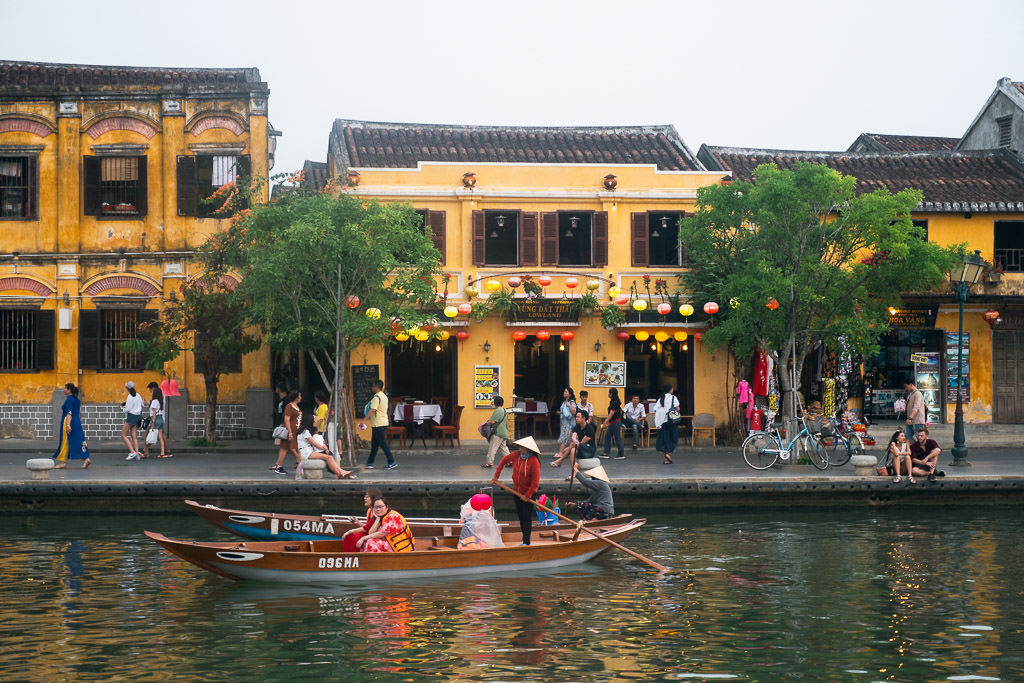
After Hoi An, you can easily fly back to Hanoi, or on to Ho Chi Minh City from where you can fly out.
The two-week Vietnam itinerary would look like this:
- Day 1 – 3: Hanoi
- Day 4 – 5: Sapa
- Day 6 – 7: Halong Bay
- Day 8 – 9: Hue
- Day 10 – 14: Hoi An
Alternatives in Vietnam
I should say that Sapa and Halong Bay are very popular destinations on the standard Vietnam tourism track. It’s worth researching these places carefully to ensure you’ll have the experience you want. Our in-depth guide to Sapa will help you avoid the tourist traps and get the best of this mountain town among the terraced rice fields. There are also these Sapa alternatives to consider.
Halong Bay can feel like an obligatory stop, but there are some alternatives here too. You could stay on the island of Cat Ba or go to Tam Coc on the way to Hue, which is often described as “Ha Long Bay but on land”. Since you’re not on a cruise here, Tam Coc offers more flexibility to explore the karst landscapes in various ways.
In my opinion, Vietnam truly shines the further away you get from the commercial beach districts in places like Nha Trang or Phu Quoc. My best memories are of motorbiking around the rice-field-clad landscapes in the interior, or exploring caves in Phong Nha-Ke Bang.
My no. 1 tip: if someone tells you they didn’t like Vietnam, ask specifically where they went.


WHAT TO READ:
2 Weeks of island hopping in Palawan
Best for: Stunning beaches and islands
I can’t think of a region better for island hopping than the archipelagic province of Palawan in the Philippines. The pristine beaches backed by dramatic karst cliffs and the hidden, jungled lagoons are just the kind of dreamy locations that come to mind when you’re thinking of a tropical paradise.
The only catch? Well, it can honestly be a bit tricky getting to the Philippines.
There are simply far fewer direct flights to Manila than to Bangkok and other hubs, especially if (like me) you are coming from Europe. And once you’ve landed in the (mostly unappealing and skippable) capital, you still need to go on another flight to get to the island you actually want to explore. So the initial effort is a bit high, though the rewards are definitely worth it.


There are numerous islands to explore in the Philippines, but Palawan stands out to me as the perfect 2-week beaches and islands escape. It’s certainly on the tourist trail, but it’s far less developed compared to the Thai coast, and its beaches easily blow Bali’s out of the water. You can expect incredible dive sites littered with shipwrecks, powdery white beaches, secret lagoons, and crystal-clear blue ocean waters.
Here’s the route at a glance:
- Day 1 : Arrival in Manila (layover only)
- Day 2 : Explore Puerto Princesa, do nearby day trip (like firefly tour)
- Days 3 – 4: Stay in Sabang, see underground river
- Days 5 – 7: Relax in Port Barton
- Day 8 – 11: El Nido, island hopping
- Day 12 – 14: Busuanga Island, flight back to Manila
(Note: my detailed Palawan itinerary has the full breakdown!)
Puerto Princesa is the gateway to Palawan. While this city is not particularly remarkable, it’s a great hub for some warm-up activities. You can go on a magical firefly-watching cruise on the Iwahig River, where you paddle out into the darkness of the mangrove forests to see the firefly show – a truly mesmerizing experience.
From the island capital, you can head via land to the laid-back beach town of Sabang to visit the Puerto Princesa Underground River. It’s a recognized UNESCO World Heritage Site, snaking for 8km through the mountains and eventually opening up into the sea. It’s possible to explore the first 1.5km or so of the river chambers, revealing huge chasms filled with stalactites and stalagmites along the way.
There are also plenty of other things to keep you busy including paddling through the mangroves, bird watching, and hiking.

You can then go overland again to the quiet village of Port Barton for some relaxing beach time. This backpacker beach town is still somewhat under the radar, offering undisturbed island hopping and some amazing snorkelling. It’s a rustic village with only basic accommodation.
El Nido is the main hub of this itinerary, offering four different island-hopping itineraries to the nearby islands and lagoons, as well as a wide range of accommodation — from hostels to resorts.
The Secret Beach is one of the highlights – nestled behind a small entrance in the limestone rocks. Backed by epic limestone cliffs, El Nido is one of the most scenic towns I’ve ever witnessed, reminding me of Krabi in Thailand.
The final part of the itinerary is the island of Busuanga (sometimes referred to as Coron, for one of its satellite islands). It’s a 4-hour ferry ride from El Nido. Busuanga offers even more island hopping, hiking, and snorkelling possibilities. From here, it’s an easy flight back to Manila.

Alternatives in the Philippines
Palawan is my go-to recommendation, but with over 7,000 islands in the Philippines, the options can feel almost limitless. The logistics aren’t always favorable though, with some destinations feeling locked behind domestic flights or long ferries – better if you’re backpacking than on a quick, 2-week trip.
That said, another great starting point is Cebu, the Philippines’ second-biggest city that is also home to a major airport. A whole web of beach destinations can be found around this node, including Moalboal in Cebu, Siquijor island, and quirky Bohol. While it has less of the spectacular cliffs and secret lagoons that define, Palawan, it’s another authentic pick for island hopping.
WHAT TO READ:
2 Weeks in Malaysia and Borneo
Best for: Vibrant multicultural cities combined with wildlife adventures
Malaysia is overall a calmer and more organized country than some of its neighbors. You still have all those lively streets inviting unscripted exploration, and Malaysia’s multicultural diversity is arguably unmatched in the region — its cuisine bringing together Malay, Indian, Chinese, and other influences. However, it’s much less over-the-top with its nightlife and entertainment, and arguably more family-friendly.
If you want Full Moon Parties and drinking alcohol from buckets, Thailand is the destination for you. But if you’re more into history, culture, and wildlife experiences, then you’ll be right at home in Malaysia.


There are essentially two parts to Malaysia: the peninsula that connects to southern Thailand, home to its capital and biggest cities. And then there’s the Malaysian part of Borneo, sharing a border with Indonesia, which despite having several cities is more rustic overall and best for nature experiences.
The great thing is that you can focus on one or the other (or both) depending on your interests. Here, let me lay out how you can have a bit of both in the span of two weeks.
This itinerary begins in the capital Kuala Lumpur, where I’d recommend staying for a day or two. It’s the modern and sprawling commercial heart of Malaysia. Check out the Batu Caves and wander Merdeka Square. You can check our guides to day trips from Kuala Lumpur for some side-trip ideas.
I then suggest making the island of Penang, home to the cosy historical town of George Town, your main base. It’s a comfortable 4-hour train ride from Kuala Lumpur to Butterworth, then a short ferry to George Town.
Penang has an excellent variety of activities, including beaches, temples, waterfalls, hiking trails, and food markets. This makes it very easy to shape your experience according to your interests, even giving you the flexibility to decide what to do at the last minute every morning. Spend at least 3 or 4 days here as it’s a perfect travel hub.
Our full guides to Penang and Georgetown offer more inspiration.


Next, fly direct from Penang to Kota Kinabalu, the city in northern Borneo. From here, you can go in a multitude of directions to explore the spectacular nature and wildlife. You can:
- Head to Semporna for some of the world’s best diving and snorkeling sites, including the island of Pulau Sipadan, which was originally popularized by legendary ocean explorer Jacques Cousteau.
- Go to Kinabatangan for a river cruise through the jungle. This is typically a 2-day tour, including an overnight stay deep in the rainforest. On my trip I saw crocodiles, numerous tropical birds, and groups of proboscis monkeys. Some even report seeing orangutans.
- Climb Mount Kinabalu, at 4,095m one of the highest peaks in Southeast Asia – typically a 2-day organized tour where you sleep in a mountain hut before making your morning ascent. (Usually needs to be booked far in advance as visitor numbers are capped.)
- Go to the Sepilok Orangutan Rehabilitation Centre for near-guaranteed orangutan encounters living in a semi-wild enclosure.
If you want the true Borneo experience, the way you might imagine from a David Attenborough nature documentary, then the place to go is Danum Valley, one of the oldest and most undisturbed rainforests on Earth. However, due to its remoteness, this will require 3 to 4 days on its own.
While Penang in mainland Malaysia lends itself well to DIY-style travel, Borneo’s more remote sites make it essential to prebook some organized local tours that include transportation to and from the wildlife areas.

The two-week Malaysia and Borneo itinerary is summarized below:
- Day 1 – 2 : Kuala Lumpur
- Day 3 – 7 : Penang
- Day 8 : travel to Kota Kinabalu, explore the city
- Day 9 – 10: Climb Mt. Kinabalu
- Day 11 – 12: Kinabatangan River Cruise
- Day 13: Orangutans at Sandakan & back to Kota Kinabalu
- Day 14: Kuala Lumpur
Alternative: 2 weeks in Borneo
If wildlife and natural wonders are your main interest, you could also spend your entire 2 weeks in Borneo, covering both Sabah and Sarawak states. Besides the aforementioned pins around Kota Kinabalu, you can continue to explore further west.
Take a flight from Kota Kinabalu to Mulu Airport, from where you can explore Gunung Mulu National Park, home to some of the world’s biggest caves.

Then, hop over to Kuching, the capital of Sarawak, for the next part of the adventure. There are some amazing sites to explore like hiking in the Bako National Park, coming face-to-face with orangutans at the Semenggoh Nature Reserve, exploring the local cuisine, and walking along the iconic Kuching Waterfront.
The unique cultural attraction around here is the traditional longhouse villages of the Sarawak tribes, which can be visited as part of a tour or homestay experience.

I’m a backpacker who usually prefers overland travel, which is why I used to think of Malaysian Borneo as a bit of a planning chore. It involves many flights (usually 5 if doing both Sabah and Sarawak) and pre-booked tours.
However, road improvements in recent years have made it more feasible for overlanding. The trip from Miri to Kuching now takes about 10 hours overland, versus 15 hours previously. If you break up the journey somewhere, for instance in Sibu for the Iban longhouses along the Rajang River, it becomes fairly manageable.
As I write this in 2026 there are planned road upgrades around Kota Kinabalu / Brunei, which may further streamline things in future. But if you don’t want to be slowed down with long-distance buses at all, you’ll have to tightly plan your sequence of flights and local tours.
WHAT TO READ:
So there you have it, 5 bite-size itinerary ideas. Keep in mind, this is just the overview — and the real travel planning begins when you dive into our country- or region-specific guides.
Thinking of a longer trip?
If you have the opportunity to travel longer than 2 weeks, then Southeast Asia can be one of the most cost-effective places in the world to plan an extended trip!
You can check out my Southeast Asia travel budgets overview and my longer itineraries for 1 to 6 months for ideas on how to string multiple countries together in a single route.