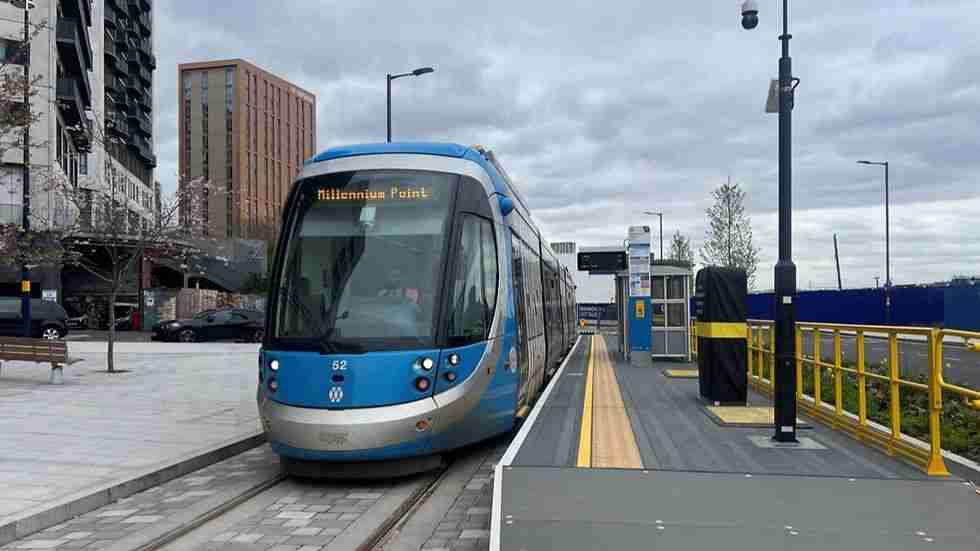
Image Credit: Birmingham Metro
Tourists visiting Birmingham will face a kind of transformation concerning the possibility of moving around the city as a result of the Eastside Metro line extension that will serve the HS2 Curzon Street station under construction by October 2026, offering passenger service to Digbeth by 2028. However, apart from the construction of the high-speed train station itself, it makes the most sense to have a connection to the tram that would enable passengers from the national coaches to access the public transport system of Birmingham, as well as create an area that is going to offer the possibility of developing over 6,000 houses and 300,000 sq m of offices.
Advertisement
Advertisement
Birmingham’s Overlooked Opportunity Is the Connection Between National Coaches and Local Trams
While much attention has focused on the construction of HS2 Curzon Street station, another important transport development is taking shape nearby.
The Birmingham Eastside Metro extension is designed to connect the city-centre tram network with Digbeth, home to Birmingham Coach Station.
Advertisement
Advertisement
This creates an opportunity to improve the final stage of journeys for people arriving in the city by long-distance coach.
Coach passengers may currently need to walk, use buses or arrange other transport to reach destinations beyond Digbeth. The new tram connection could offer another option for onward journeys.
Advertisement
Advertisement
It could be especially useful for visitors who are unfamiliar with Birmingham, travelling with luggage or arriving for short stays.
The significance becomes clearer when the extension is viewed as part of a wider interchange network.
Advertisement
Advertisement
In April 2026, the first section of the Eastside Metro extension opened between Bull Street and Millennium Point, introducing two stops. One serves the Albert Street area near Moor Street’s established bus interchange.
According to the West Midlands Combined Authority, around 400,000 bus passengers use the Moor Street interchange each week.
That figure relates to existing local bus passengers, not predicted users of the new Metro service.
Nevertheless, it illustrates the scale of passenger activity near the developing Eastside transport corridor.
Advertisement
Advertisement
Once the Digbeth section opens, Birmingham could have stronger connections between local bus services, existing railway stations, national coach services and the Metro network.
The opportunity is therefore not simply to introduce another tram destination. It is to make journeys involving several types of transport easier to manage.
Why the October 2026 Construction Milestone Matters for Birmingham Coach Passengers
The latest announcement from the West Midlands Combined Authority confirms that Midland Metro Alliance contractors have gained access to the first section of the HS2 Curzon Street station site.
This allows preparations for tram tracks to begin along the unfinished central section of the extension.
At the eastern end, major track construction along Digbeth High Street is already complete. Work has also progressed into Meriden Street.
The remaining challenge is to connect these sections through the Curzon Street construction area.
Advertisement
Advertisement
HS2 and the Metro project share an important part of the route. The station structure must accommodate trams travelling beneath it.
A second land handover is scheduled for spring 2027, following further structural work.
Passenger tram services to Digbeth Coach Station are targeted for 2028.
However, the tram stop at Curzon Street itself is scheduled to open later, alongside the future HS2 station.
For coach passengers, this distinction is important.
The planned 2028 service could make the local tram network more accessible from Digbeth without requiring the high-speed railway station to be operational.
Advertisement
Advertisement
It also means travel businesses should not describe the full HS2 interchange as opening in 2028.
The confirmed development is an advance in construction, with the completion of the Digbeth connection remaining a future milestone.
The 1.7-Kilometre Tram Link Could Change Birmingham’s Visitor Arrival Experience
The Birmingham Eastside extension covers approximately 1.7 kilometres and includes four permanent tram stops.
Although relatively short, its position gives it considerable importance.
The line branches from the existing Metro network at Bull Street and travels towards Digbeth, connecting parts of central Birmingham that support different types of passenger journeys.
Advertisement
Advertisement
It brings together commercial areas, educational facilities, cultural destinations and important transport connections.
For someone arriving by coach, better access to the Metro could eventually simplify travel to parts of the wider city and West Midlands.
Visitors arriving by train may also benefit from stronger connections between Moor Street, Eastside and Digbeth.
The Midland Metro Alliance additionally identifies a planned interchange near the Clayton Hotel involving bus, Sprint and coach connections.
These proposals demonstrate how the scheme is intended to function as part of an integrated system rather than a stand-alone tram route.
However, direct journey-time savings have not yet been established for individual coach-to-tram connections.
Advertisement
Advertisement
Passengers should therefore treat the potential convenience as a future benefit, not a guaranteed reduction in travel time.
Digbeth’s 6,000-Home Development Opportunity Gives the Tram Link a New Economic Purpose
A major reason to examine the Metro extension differently is Birmingham City Council’s latest regeneration planning.
The council’s Digbeth Prospectus 2025, updated in February 2026, identifies development opportunities that could deliver more than 6,000 homes and 300,000 square metres of commercial floorspace.
These are potential development capacities, not completed construction or firm delivery commitments.
Even so, they reveal the scale of change being considered for Digbeth.
A district with more residents and commercial activity will also require effective transport connections.
Advertisement
Advertisement
People need to reach employment, schools, shops, entertainment and public services.
Businesses need accessible premises for their employees, customers and visitors.
The new Metro corridor could support this changing pattern of local travel.
It may also strengthen Digbeth’s appeal to firms seeking premises outside Birmingham’s established commercial core.
The district already contains a mix of creative businesses, cultural venues and growing media activity.
Birmingham City Council identifies television and film production facilities among the area’s expanding commercial uses.
Advertisement
Advertisement
As residential and employment development advances, the demand for practical public transport connections could become increasingly important.
This gives the Metro project a dual purpose: improving visitor access and helping support the longer-term growth of a mixed-use urban neighbourhood.
The two objectives are closely connected because places that are easier to reach for residents and workers can also become more convenient for tourists.
Birmingham’s £15.4 Million Digbeth Street Investment Could Make the Tram More Useful for Tourists
A transport connection becomes more valuable when the surrounding streets are convenient and attractive for passengers.
Birmingham City Council recognised this principle when it announced £15.4 million in Enterprise Zone funding for improvements to Digbeth High Street in May 2021, alongside an additional £272,000 from the council.
The programme was designed to improve the public realm while accommodating the Eastside Metro extension.
Advertisement
Advertisement
Its plans include wider pedestrian areas, improved cycling facilities, greenery, street lighting and changes to the way traffic moves through Digbeth.
These improvements are important for visitors arriving at Birmingham Coach Station.
A tram stop may provide a convenient connection, but the overall passenger experience depends on the streets between the station, transport stops, accommodation and attractions.
Clear pedestrian routes can make unfamiliar districts easier to navigate.
Better lighting and accessible crossings also contribute to the practical quality of a journey.
For the hospitality sector, the potential benefit is straightforward. Visitors who can move around comfortably may find it easier to explore restaurants, independent shops and entertainment venues beyond their original destination.
Advertisement
Advertisement
The council has specifically identified increased pedestrian activity and support for local businesses as objectives of the public realm improvements.
However, there is no verified evidence that the street programme has already produced a particular increase in tourism revenue.
The important relationship is between investments in the physical environment and the transport options available to people using it.
A completed Metro extension, supported by attractive public spaces, could make Digbeth more convenient to explore on foot and by tram.
Why Birmingham Coach Station Could Become a More Important Gateway for UK City Breaks
Long-distance coaches serve a distinct segment of the domestic travel market.
They provide scheduled connections between cities and can be particularly relevant to passengers who prioritise affordability or prefer not to drive.
Advertisement
Advertisement
Birmingham Coach Station’s location in Digbeth means many arriving passengers begin their visit away from the city’s principal shopping and commercial areas.
The Eastside Metro extension could change the range of onward travel options available to them.
For example, passengers might be able to combine coach travel with local tram services to continue towards other parts of central Birmingham.
Visitors planning a short break could also use the connection to reach further destinations served by the existing West Midlands Metro network.
That does not mean every journey will become direct. Some passengers will still need to walk or change services.
Nevertheless, a stronger interchange can reduce dependence on taxis or private vehicles for certain journeys.
Advertisement
Advertisement
This may be particularly relevant during busy weekends, major events and periods of increased visitor activity.
Birmingham City Council’s transport plans explicitly place the new tram tracks on the southern side of Digbeth High Street, closest to the coach station.
This alignment supports the possibility of convenient interchange, although the actual walking distance, stop layout and journey times should be confirmed when final passenger information becomes available.
The result could be an improved first impression of Birmingham for travellers entering the city by coach.
Birmingham’s Coach, Bus, Rail and Metro Connections: What Changes by 2028?
| Transport connection | Position in October 2026 | Potential change | Passenger significance |
|---|---|---|---|
| Birmingham Coach Station | Operating in Digbeth | Nearby Metro services targeted for 2028 | More options for onward journeys |
| Moor Street railway station | Existing railway services | Improved connections through the Eastside Metro corridor | Greater flexibility between rail and tram |
| Moor Street bus interchange | Established interchange serving around 400,000 bus passengers weekly | Already linked to the first Eastside tram phase | Stronger local multimodal connections |
| Millennium Point | Tram services operating since April 2026 | Becomes an intermediate stop when Digbeth services begin | Better access across Eastside |
| Digbeth High Street | Main tram track works completed | Passenger tram services targeted for 2028 | Improved access for visitors and residents |
| HS2 Curzon Street | Main station under construction | Future interchange with Metro | National high-speed and local transport integration |
| Birmingham Sports Quarter | Future development and transport proposals | Metro extension aimed at 2031 | Potential connections for sporting and entertainment events |
Comparison based on WMCA, Birmingham City Council, Midland Metro Alliance, HS2 and TfWM publications. Future changes remain subject to project delivery.
The comparison reveals a key difference between Birmingham’s transport projects.
Advertisement
Advertisement
Some services already exist, some are nearing completion, and others remain longer-term proposals.
The most immediate opportunity is to strengthen connections between established transport facilities rather than waiting for every planned investment to be delivered.
For the travel industry, this provides a clearer way to communicate Birmingham’s changing accessibility without overstating the status of future infrastructure.
Could the Metro Help Birmingham Attract More Visitors to Digbeth’s Creative District?
Digbeth’s identity extends beyond transport infrastructure.
Birmingham City Council describes the district as a centre of creative, community and cultural activity.
It has established connections with art, music, television production and independent enterprise.
Advertisement
Advertisement
These activities create reasons for people to visit the area throughout the day and evening.
Improved public transport could help more visitors combine Digbeth with other parts of Birmingham during a single trip.
A traveller might arrive at Moor Street, explore cultural attractions in Eastside and continue to Digbeth for food or entertainment.
Similarly, someone arriving at Birmingham Coach Station might find it easier to travel to additional neighbourhoods before leaving the city.
The potential value lies in expanding the practical range of a visitor’s itinerary.
For hospitality businesses, greater accessibility could support customer visits from people staying elsewhere in Birmingham or travelling from neighbouring areas.
Advertisement
Advertisement
However, more trams do not automatically translate into more overnight stays.
That outcome will depend on accommodation supply, event programming, attractions, service quality and wider visitor demand.
A rigorous assessment would examine whether the extension helps businesses attract customers who previously found Digbeth less convenient to reach.
It would also consider whether passengers use the Metro for additional leisure trips or simply switch from existing modes of transport.
This distinction is essential when estimating tourism benefits.
The strongest argument for the extension is therefore improved accessibility, with visitor growth remaining a potential consequence rather than an established result.
Advertisement
Advertisement
What Others Are Missing About Birmingham’s Future High-Speed Railway Connection
The new tram route has often been discussed in relation to HS2 Curzon Street station.
However, the official construction programme creates an important distinction between the first Metro benefits and the eventual high-speed railway interchange.
Passenger services into Digbeth are targeted for 2028.
The Curzon Street tram stop is expected to open alongside the HS2 station at a later stage.
This means Birmingham has an opportunity to improve local connectivity before the national high-speed railway infrastructure becomes fully operational.
It also provides time for authorities and businesses to understand passenger demand along the Eastside corridor.
Advertisement
Advertisement
The eventual HS2 interchange could then add another source of journeys to an established tram network.
According to HS2 Ltd, the new Curzon Street station is planned to provide connections with local buses and Metro services, with Moor Street station nearby.
HS2 also identifies the new tram stop beneath its station as part of the design.
This approach could bring national and local journeys closer together.
But the full interchange will only become effective when the different services operate in a coordinated manner.
A convenient connection requires more than adjacent tracks.
Advertisement
Advertisement
Passengers need clear signage, accessible pedestrian routes, reliable services and useful travel information.
For coach passengers, the eventual network could create additional opportunities to combine long-distance road transport, local trams and railway services.
That is the wider transport story behind the 2026 construction announcement.
The Future Sports Quarter Adds Another Dimension to Birmingham’s Coach-to-Tram Network
The Eastside Metro extension could also become the foundation for future journeys beyond Digbeth.
Transport for West Midlands is developing plans to extend the tram network towards Birmingham’s proposed Sports Quarter.
The route would build upon the Eastside line and continue through parts of east Birmingham, including Bordesley and the St Andrew’s area.
Advertisement
Advertisement
TfWM currently aims to introduce passenger services on the proposed extension by 2031.
This remains a target rather than a confirmed opening date.
The Sports Quarter proposals include Birmingham City Football Club’s planned Powerhouse Stadium.
Major sporting and entertainment venues can generate concentrated passenger demand before and after events.
An extended tram network could help distribute that demand across the city.
The potential implications for coach travel are particularly interesting.
Advertisement
Advertisement
Supporters arriving in Birmingham by coach could eventually gain additional public transport options when travelling towards sporting venues.
However, there is no confirmed evidence establishing the number of coach passengers who would use such a connection.
Further planning would also be needed to assess event-day operating capacity, service frequency and interchange arrangements.
Nevertheless, the longer-term Metro proposals indicate that Digbeth could become a connecting point between central Birmingham and growing destinations further east.
Completing the 2028 connection is therefore relevant to more than the current city-centre travel market.
What Birmingham Must Get Right Before the 2028 Metro Opening
Infrastructure delivery is only the first stage of creating an effective transport interchange.
Advertisement
Advertisement
For visitors arriving by coach, the usefulness of the new Metro connection will depend on how easily they can understand and use it.
Several practical questions will require clear answers before passenger services begin.
- Walking access: How straightforward will the route be between Birmingham Coach Station and the new tram stop?
- Passenger information: Will visitors receive clear guidance on destinations, connections, fares and service frequency?
- Accessibility: Will the interchange offer suitable routes for wheelchair users, people with reduced mobility and passengers carrying heavy luggage?
- Service coordination: Will tram operating hours and frequencies support the needs of different passenger groups?
- Visitor wayfinding: Will signage clearly identify Digbeth attractions, nearby railway stations and connections to the wider Metro network?
These are editorial assessment criteria rather than unresolved failings identified by the project authorities.
Providing clear answers would help visitors make better transport decisions.
It would also support travel businesses advertising Birmingham city breaks or selling journeys involving several forms of public transport.
In the meantime, construction disruption remains a practical consideration.
Advertisement
Advertisement
Transport for West Midlands has warned that travel arrangements in Eastside may change while the work continues.
Passengers should check official updates, follow diversion information and allow additional journey time.
The benefits of the completed route will be easier to realise if travellers remain well informed during the construction period.
Travel Analytics: How Birmingham Can Measure the Success of Its New Coach-to-Tram Connection
A meaningful assessment of the Eastside Metro extension should focus on actual passenger behaviour rather than relying solely on forecasts of wider economic growth.
Five indicators would be especially useful.
| Analytical measure | Suggested evaluation method | Relevance to tourism and transport |
|---|---|---|
| Coach-to-tram transfers | Passenger surveys and interchange counts | Determines whether coach passengers use the Metro |
| Interchange time | Measured walking and waiting times | Evaluates convenience |
| Visitor movement | Surveys at Digbeth destinations and transport stops | Identifies changes in local travel patterns |
| Business activity | Comparable visitor and trading data before and after opening | Tests possible commercial effects |
| Passenger experience | Satisfaction, accessibility and reliability measures | Assesses the quality of the completed connection |
These are proposed measures for future evaluation, not existing performance statistics.
Advertisement
Advertisement
No official figures identified in this research establish how much additional tourist spending the extension will generate.
There is also no verified forecast quantifying the number of national coach passengers expected to transfer onto the Metro.
Inventing either figure would create a misleading impression of economic certainty.
A better analytical approach would collect baseline data before opening and compare subsequent performance over several years.
That would make it possible to distinguish increased passenger demand from travellers changing their existing transport choices.
Further analysis could examine whether visitors remain in Digbeth longer, explore additional attractions or find access to accommodation easier.
Advertisement
Advertisement
The resulting evidence would help transport authorities, tourism organisations and businesses assess the practical value of the investment.
The Bigger Picture: Birmingham’s £1.3 Billion Metro Programme Could Support More Connected Travel
The Eastside extension is one element of a much larger regional transport strategy.
Transport for West Midlands reported in October 2026 that approximately £1.3 billion of investment was planned for the West Midlands Metro network over the following decade.
This investment programme extends beyond Birmingham’s eastern districts.
Its wider purpose is to improve connections between communities, employment centres and important regional destinations.
The significance for visitors lies in creating a more extensive public transport network that can support journeys beyond one city-centre corridor.
Advertisement
Advertisement
Improved interchange arrangements could allow passengers to combine different services more effectively.
For Birmingham Coach Station, integration with an expanding Metro network may increase the range of onward destinations accessible without a private vehicle.
The eventual value will depend on network coverage, service quality and the ease of transferring between transport modes.
Importantly, the £1.3 billion figure covers broader regional Metro investment. It should not be presented as the construction budget for the Eastside extension alone.
The coach-to-tram opportunity is therefore one potential benefit of a much wider transport programme.
Conclusion: Birmingham’s Most Important Travel Opportunity May Be Waiting in Digbeth
In this regard, construction of Eastside Metro project can be considered an important success for providing development of an efficient transport system in the United Kingdom. First and foremost, the provision of passenger transport services from Digbeth beginning 2028 will ensure convenience of transport services and ensure that the visitors, business people, and passengers are connected to their places of work or recreation.
Advertisement
Advertisement
The inclusion of Metro into the future HS2 Curzon Street station will play an important role in the promotion of Birmingham as one of the transport centers in England. Regarding the development of the tourism sector, the increased connectivity will bring prosperity of Digbeth and other emerging areas. The economic benefits of the project will depend on the demand and the quality of services provided by the passengers.