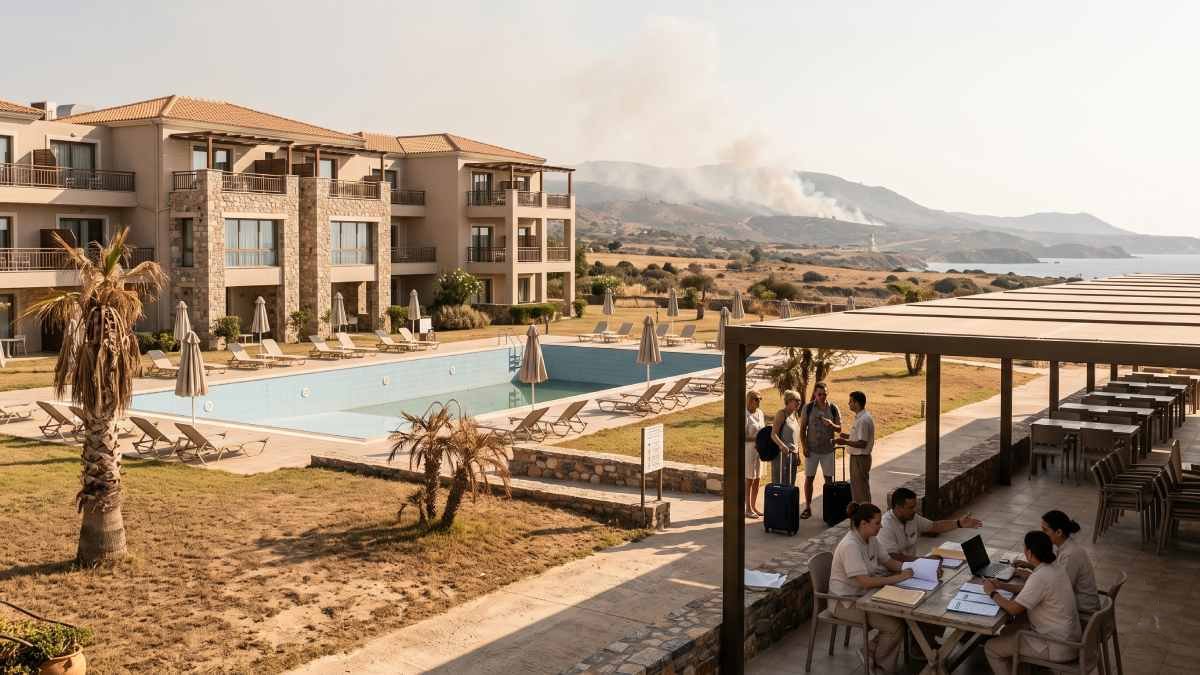
There has emerged a serious commercial dispute situation in the Mediterranean hospitality industry because of the unforeseen extreme weather conditions affecting Southern Europe. In Greece, Spain, and Italy, expensive holiday hotels are regularly closed because of heat waves, water conservation measures, and thick smoke from wild fires without any damage to property being suffered. Claims for compensation are regularly denied by insurance companies leading to serious commercial disputes over non-damage business interruption insurance. The minute scrutiny of these disputes in arbitration courts brings about the collapse of top-line income figures. The settlement of these complex disputes in the hospitality industry comes about through a forensic approach where the avoided cost of operation is stripped off and real economic factors are determined.
The Southern European NDBI Tension: Physical Loss Triggers Versus Climate Paralysis
The underwriting architecture governing commercial property insurance across the European Union remains anchored in an industrial-era doctrine: direct physical damage to insured real estate is treated as an indispensable prerequisite for indemnification. When Mediterranean tourist corridors are enveloped by severe convective heat domes, regional hydrological deficits, or heavy particulate wildfire smoke plumes, operational paralysis is regularly experienced by luxury resort complexes while their structural fabric remains undamaged. Standard property insurance contracts feature business interruption clauses whereby claims are denied when physical alteration of the premises is absent.
Acute legal friction across Southern European tourist destinations is generated by this divergence between physical integrity and commercial functionality. Preventative evacuation orders are frequently issued, hydrological emergencies are declared, or utility supplies are rationed by municipal authorities to safeguard public health and critical domestic infrastructure. The earning capacity of hotels is extinguished by these regulatory and environmental interventions without scorched facades, broken masonry, or collapsed roofs being produced.
When non-damage business interruption claims are filed by hoteliers, coverage is rejected by primary underwriters citing standard property damage exclusion clauses. It is maintained by insurers that operational halts driven by ambient heat, municipal rationing, or external smoke haze represent uninsurable trading contingencies rather than indemnifiable property casualties. In response, policyholders are required by European commercial arbitration panels to abandon simplistic top-line revenue claims in favour of a mathematically rigorous forensic assessment. Genuine lost net profit is isolated by filtering out regional macroeconomic downturns, removing variable overhead costs that were never incurred, and reimbursing justifiable emergency mitigation measures. These variables are established through forensic audits of municipal decrees, tour wholesaler cancellations, collective labour arrangements, and competitive benchmarking indices.
Hospitality Forensic Accounting: Operational Reality Versus Theoretical Accounting
In hospitality arbitration, financial assessments are frequently caused to collapse because theoretical financial models fail to be aligned with real-world hotel operations. It has been established by hospitality forensic authority Gary Isenberg that economic damages in hotel business interruption claims are not automatically equated with a reduction in top-line revenue. A perishable inventory model is operated by hotels: an unsold room night represents revenue that is permanently extinguished once the night passes. However, when guest occupancy is prevented by an external disruption, the incurring of critical variable operating expenses is also avoided by the hotel.
Inflated damage assessments that are dismissed by arbitral tribunals are produced when gross contracted room revenue or unadjusted food and beverage sales are claimed. A defensible claim requires the construction of an objective forensic counterfactual revenue projection, the benchmarking of the hotel against an immediate competitive set, the application of macro trend deductions, and the deduction of all avoided variable costs.
Advertisement
Advertisement
Baseline overhead that must be covered by lost net operating margins is formed by fixed costs—such as real estate depreciation, property debt servicing, permanent executive payroll, and ground leases—which continue unabated during a temporary shutdown. Conversely, variable operating costs fluctuate directly with daily room occupancy and restaurant covers.
When a resort is paralyzed by a climate event, unperformed housekeeping labour, unwashed guest linens, unconsumed guest room amenities, reduced utility loads, and unserved food provisions are extracted from the general ledger by forensic adjusters. Compensation strictly for lost net operating profit is ensured by the deduction of these unexpended variable costs, preventing the recovery of expenses that were never incurred.
Advertisement
Advertisement
Comparative Frameworks and Jurisdictional Blueprints
Greek Wildfires, Civil Orders, and Seasonal Labour Law
During extreme wildfire emergencies across Rhodes and Attica, alongside protracted heatwaves exceeding forty degrees Celsius in Crete, operational paralysis was suffered by dozens of luxury resort complexes despite zero structural flame damage being sustained. The physical properties—including guest villas, swimming pools, and architectural infrastructure—remained intact, but operations were rendered impossible by heavy smoke plumes, utility grid failures, and official evacuation orders.
The first evidentiary barrier involves wholesaler cancellation clawbacks under the European Union Package Travel Directive. Article 12(2) of Directive (EU) 2015/2302 was invoked by major European travel conglomerates, including TUI and DER Touristik. The termination of contracts without penalty prior to departure is permitted by this provision in the event of unavoidable and extraordinary circumstances occurring at the place of destination or its immediate vicinity and significantly affecting the performance of the package.
Immediate chargeback notices were issued and future payments were offset against cancellations by wholesalers, causing anticipated summer cash flows to be removed. Complete electronic records of these wholesale settlement adjustments must be audited and presented by hotel claimants to prove involuntary revenue loss.
A secondary challenge is faced by policyholders under the civil authority coverage clause. It is often required by standard insurance policies that access to the property be prohibited by an order of civil authority resulting directly from physical damage to adjacent premises.
Advertisement
Advertisement
Broad municipal or regional safety evacuations rather than commercial closure orders directed at a specific property title are represented by declarations issued by the Greek General Secretariat for Civil Protection (Γενική Γραμματεία Πολιτικής Προστασίας), which are typically broadcast via the emergency 112 cellular network. It is argued by underwriters that policy definitions requiring property-specific civil orders fail to be satisfied by generic perimeter alerts.
These revenue shocks must be balanced by forensic adjusters against the national collective labour framework (Συλλογικές Συμβάσεις Εργασίας Ξενοδοχοϋπαλλήλων). Statutory re-employment rights are granted to seasonal hospitality staff by Greek labour statutes. When climate disruptions occur, emergency administrative mechanisms allowing the suspension of employment contracts (αναστολή συμβάσεων εργασίας) are routinely established by the Greek Ministry of Labour.
Under these statutory suspensions, special purpose compensation (αποζημίωση ειδικού σκοπού) is paid directly to workers by the state while social security contributions are funded. When avoided variable costs are calculated, enterprise submissions to the ERGANI labour reporting database are audited: seasonal staff wages covered by state support are deducted from the claim as avoided costs, while non-exempt salaried managerial compensation is retained as compensable fixed overhead.
Spanish Drought Restrictions, CCS Exclusions, and Comp-Set Analysis
Across Andalusia (Málaga, Seville), Catalonia, and the Balearic Islands, emergency water restrictions were enacted by regional authorities under regional drought plans (Plan Especial de Sequía) due to prolonged droughts. Municipal regulations capping water usage between 100 and 115 litres per guest per day were faced by luxury resort properties. The refilling of swimming pools, the irrigation of gardens, and the operation of hydrotherapy circuits were prohibited by these decrees, whereby the luxury guest experience was undermined.
Private water hauliers (camiones cisterna) were contracted by hoteliers to maintain essential sanitary systems and prevent immediate guest departures, incurring substantial weekly haulage costs. In arbitration, these transport invoices are presented as compensable mitigation expenses incurred under the doctrine of salvage, with the argument being made that total operational shutdown was prevented and losses were mitigated by emergency water supplies.
It is countered by underwriters that the procurement of basic municipal utilities constitutes routine operational overhead rather than an insurable mitigation expense under a property damage policy.
Advertisement
Advertisement
A significant hurdle in Spain is presented by the regulatory mandate of the public catastrophe fund, the Consorcio de Compensación de Seguros (CCS). Although extraordinary natural risks are covered by the CCS, a closed list of covered perils is contained within its statutory charter, primarily floods, earthquakes, volcanic eruptions, and cyclonic winds over 120 km/h. Drought (sequía) is excluded from CCS property insurance and is restricted to agricultural policies managed through Agroseguro.
Furthermore, direct physical damage to insured assets (daño directo en los bienes asegurados) is required for business interruption indemnity by the CCS. Non-damage disruptions caused by water rationing are excluded from this public backstop, leaving hoteliers dependent on private policies.
The separation of property-specific losses from broader market declines is also required in Spanish forensic analysis. When regional tourism is depressed by an extended heatwave, competitive set benchmarking data for similar properties within a 5-kilometre radius is evaluated. Any baseline contraction observed across the competitive set is stripped from the counterfactual model as an uninsurable macroeconomic trend.
Italian Hydrological Emergencies and Supervening Impossibility
In Sicily (Agrigento, Palermo, Catania) and Sardinia, a national state of emergency (stato di emergenza per deficit idrico) was declared under Civil Protection frameworks by the Italian Council of Ministers due to severe reservoir depletion. Residential networks were prioritized by municipal water distributors, redirecting piped water away from commercial hospitality connections. Municipal mains supply was lost by historic masserie and boutique coastal hotels, forcing closures of guest wings, spa facilities, and restaurants.
Departmental revenue losses were created by this operational paralysis. A substantial portion of total Gross Operating Profit is generated by food and beverage, wedding banqueting, and spa services in luxury Sicilian properties.
These high-margin revenue streams were eliminated by closing wet wellness facilities and kitchens. PMS and POS records are cross-examined by forensic adjusters to separate fixed overhead from avoided variable costs, deducting unpurchased wholesale food inventory, avoided food spoilage, and reduced electricity consumption.
Advertisement
Advertisement
A complex legal conflict is created under the doctrine of supervening impossibility (impossibilità sopravvenuta), codified in Article 1463 of the Italian Civil Code (Codice Civile). Under Article 1463, a contracting party released from performance due to supervening impossibility is precluded from demanding counter-performance and is required to return any advance payments received.
When operating was made impossible by municipal water cut-offs, reservations were legally required to be cancelled and guest deposits refunded by hoteliers. However, subsequent business interruption claims were rejected by property insurers, citing the absence of physical property damage. As a result, mandatory refund liabilities were faced by hoteliers while insurance recovery was denied.
Institutional Frameworks Across Southern Europe
| Operational & Legal Metrics | Greece (e.g., Rhodes, Crete) | Spain (e.g., Catalonia, Andalusia) | Italy (e.g., Sicily, Sardinia) |
| Primary Climate Peril | Severe wildfire smoke proximity, particulate fallout, extreme thermal alerts. | Protracted hydrological drought, municipal water limits, extreme ambient heat. | Severe reservoir depletion, municipal water diversion, acute infrastructural scarcity. |
| Administrative Trigger | General Secretariat for Civil Protection evacuation broadcasts via 112. | Regional emergency drought decrees (Plan Especial de Sequía). | Council of Ministers national state of emergency declarations (Protezione Civile). |
| Statutory Consumer Rights Trigger | Package Travel Directive (EU) 2015/2302 Art. 12(2) extraordinary circumstances. | Package Travel Directive (EU) 2015/2302 Art. 12(2); national consumer protection laws. | Italian Civil Code Article 1463 (impossibilità sopravvenuta della prestazione). |
| Labour Cost Avoidance Mechanism | Emergency statutory suspension of seasonal contracts (αναστολή συμβάσεων). | ERTE frameworks (Expediente de Regulación Temporal de Empleo) where activated. | Extraordinary wage guarantee frameworks (Cassa Integrazione Guadagni Straordinaria). |
| Public Reinsurance / Catastrophe Pool | None; private market absorption backed by ad-hoc governmental disaster decrees. | Consorcio de Compensación de Seguros (CCS); explicitly excludes drought and NDBI. | None; state emergency reserve funding (Fondo Emergenze Nazionali) lacks commercial BI indemnification. |
| Mitigation Expense Disputes | Costs of emergency structural air scrubbing, power generation, guest relocation logistics. | Haulage costs for private water tankers (camiones cisterna) contested as basic overhead. | Private industrial tanker haulage, installation of temporary external desalination scrubbers. |
European Regulatory Scrutiny: EIOPA and Macroprudential Climate Vulnerability
Scrutiny from pan-European financial regulatory authorities has been drawn by the rising frequency of non-damage climate disruptions across the Mediterranean. Warnings concerning the widening climate protection gap throughout Southern Europe have been issued by the European Insurance and Occupational Pensions Authority (EIOPA), working alongside the European Central Bank (ECB).
It is indicated by EIOPA’s Dashboard on Insurance Protection Gap for Natural Catastrophes that only approximately one-quarter of economic losses caused by extreme weather and climate events across the European Economic Area are covered by insurance. For perils such as wildfires and severe hydrological droughts in Southern Europe, the uninsured proportion regularly encompasses the vast majority of total losses.
It is highlighted in prudential assessments that climate exposure is being managed by primary commercial underwriters through defensive measures: policy deductibles are increased, premium rates are raised, and restrictive NDBI exclusions are introduced. Consequently, a shrinking availability of commercial insurance for non-damage business interruptions is faced by Mediterranean hospitality assets.
It is observed by EIOPA that secondary economic consequences—including business interruption spillovers, macro-tourism demand drops, and supply chain disruptions—fail to be accounted for in traditional catastrophe risk models. Uninsured systemic risks affecting hospitality asset valuations, banking collateral, and sovereign debt positions across tourism-dependent Mediterranean economies are thereby created.
Advertisement
Advertisement
The Paradigm Shift: Parametric Risk Hedges and Algorithmic Settlement
To address the limitations of physical damage requirements and avoid protracted forensic disputes, parametric climate risk insurance is increasingly adopted by institutional hospitality asset managers. Underwritten by syndicates at Lloyd’s of London and continental reinsurers, traditional loss adjustment procedures are dispensed with under parametric policies. Instead, indemnification is made dependent on objective, independently verified index triggers.
Environmental data provided by independent scientific institutions is relied upon in parametric structures. For drought and hydrological hedging, data feeds from the European Drought Observatory (EDO), administered by the European Commission’s Joint Research Centre, are referenced by contracts.
Payouts are tied to verified benchmarks, including Combined Drought Indicators, Soil Moisture Anomalies, or Standardized Precipitation-Evapotranspiration Indices. For extreme heat interruptions, atmospheric reanalysis data from the Copernicus Climate Change Service is deployed, allowing automatic liquidity disbursements to be executed when ambient Wet-Bulb Globe Temperatures exceed predetermined thresholds across multiple consecutive days.
Strategic Evidentiary Blueprints for International Arbitration Tribunals
The enforcement of business interruption recoveries before international arbitration panels (such as the ICC International Court of Arbitration, LCIA, or Swiss Arbitration Centre) requires an evidentiary dossier addressing both policy language and operational realities. Each component of the claim must be substantiated using five primary documentation streams:
- Administrative and Regulatory Records: An official chronology linking civil protection warnings, municipal water rationing decrees, and health ministry heat advisories to the property’s operational logs must be compiled by the claimant. Where civil authority clauses are invoked, it must be demonstrated through these records that the suspension of guest services was forced by administrative orders.
- Wholesale Cancellation Dossier: All wholesale cancellations must be documented by hoteliers, with particular focus on tour operator communications citing Directive (EU) 2015/2302 extraordinary circumstances. It is demonstrated by chargeback statements and cancellation schedules that booking losses were legally unavoidable and outside the hotel’s control.
- Departmental Operational Data: Granular departmental PMS and POS audit trails rather than high-level financial statements must be provided by claimants. Lost room nights, average daily rates, banquet cancellations, spa closures, and unserved food covers must be substantiated by these records.
- Avoided Operating Expenses Ledger: Operational savings must be accounted for within the evidentiary filing. Labour savings—including staff costs absorbed by state support programs such as the Greek contract suspension mechanism—must be documented. Additionally, savings in unpurchased food stock, laundry services, and reduced utility consumption must be shown in the general ledgers.
- Competitive Benchmarking and Mitigation Accounting: Local competitive set performance data must be provided by claimants so that the incident’s impact is isolated from broader regional market downturns. Finally, invoices for emergency outlays (such as water tanker deliveries) must be presented by operators alongside evidence of alternative revenues retained, confirming that mitigation efforts were necessary and cost-effective.
Future Outlook: Reimagining Mediterranean Tourism Resilience
The obsolescence of standard property insurance models requiring physical damage is being accelerated by the growing frequency of climate disruptions across Southern Europe. Moving forward, hybrid risk management frameworks are being adopted by institutional hotel owners, debt financiers, and global brands. Traditional property damage policies—covering catastrophic physical destruction—are combined with parametric hedges that provide immediate liquidity during non-damage heat, drought, or smoke interruptions.
Simultaneously, pressure is being exerted on European regulatory authorities and national governments to modernise state catastrophe funds. Public-private risk pools that recognise non-damage climate emergencies alongside physical perils continue to be lobbied for by industry associations, including the Hellenic Chamber of Hotels, Spain’s CEHAT, and Italy’s Federalberghi.
Advertisement
Advertisement
Until statutory insurance frameworks are adapted to shifting climatic realities, rigorous forensic accounting methodologies must be relied upon by hotel operators navigating commercial arbitration. Balance sheets can be defended against an increasingly volatile climate by grounding claims in operational realities, isolating macroeconomic trends, and properly accounting for avoided expenses.
Traditional commercial property insurance assumptions have been permanently shattered by the accelerating climate crisis across Southern Europe. Unadjusted top-line turnover figures can no longer be relied upon by Mediterranean hoteliers when claims for unexpected operational paralysis are pursued. As demonstrated across Greece, Spain, and Italy, arbitral success requires a defensible methodology whereby avoided variable overheads are methodically eliminated and macroeconomic downturns are isolated. Rigorous forensic preparation alongside modern parametric safeguards is demanded when navigating the evolving landscape of non-damage business interruption. Enterprise value against volatile regional weather can be protected only when the profound gap between theoretical accounting models and grounded operational reality is bridged by the Mediterranean hospitality sector.